







Why Scorpion Problems & Solutions Often Start In Winter
When most people think about scorpions, they think about summer.
That makes sense. Scorpions are seen more often in warm months, and that’s when most stings occur. What many homeowners don’t realize is that winter plays a major role in determining what happens later in the year.
At Seal Out Scorpions, we approach scorpion control differently than traditional pest control or contractor-grade sealing. As Arizona’s only Gold Star–rated contractor (through Building Performance Institute) focused on scorpion sealing and one of the few companies in the state formally trained in building science and building performance, we evaluate homes as systems, not as spray or caulking service targets.
After sealing and evaluating thousands of Arizona homes over more than two decades, one pattern is consistent: homes with recurring scorpion problems don’t develop those issues suddenly, the science also supports this. The conditions that allow scorpions inside are usually established months earlier.
Winter is not when scorpion problems show up or seem to temporarily go away.
It is when a home’s vulnerability is shaped or corrected for the rest of the season.
Are Scorpions Active In Winter?
Scorpions are active year-round. What changes in winter is how they move and where they position themselves.
During cooler months:
- Movement slows
- Activity becomes less visible
- Scorpions rely more on protected structural spaces
This often creates a false sense of security. While sightings decrease, the structure itself continues to influence future behavior through airflow, pressure, and access points.
Scorpions Respond To Environmental Conditions, Not Food
Scorpions do not behave like insects and do not follow food sources in the way many pest control models assume. Their movement is driven by environmental opportunity created by the structure itself.
This is where building performance matters.
In winter:
- Indoor heating increases pressure differentials
- Micro-air movement becomes more defined
- Materials are more contracted
- Other pests seek shelter, altering interior conditions
From a Building Performance Sealing™ perspective, these factors determine whether a home passively resists scorpion entry or unintentionally facilitates it.
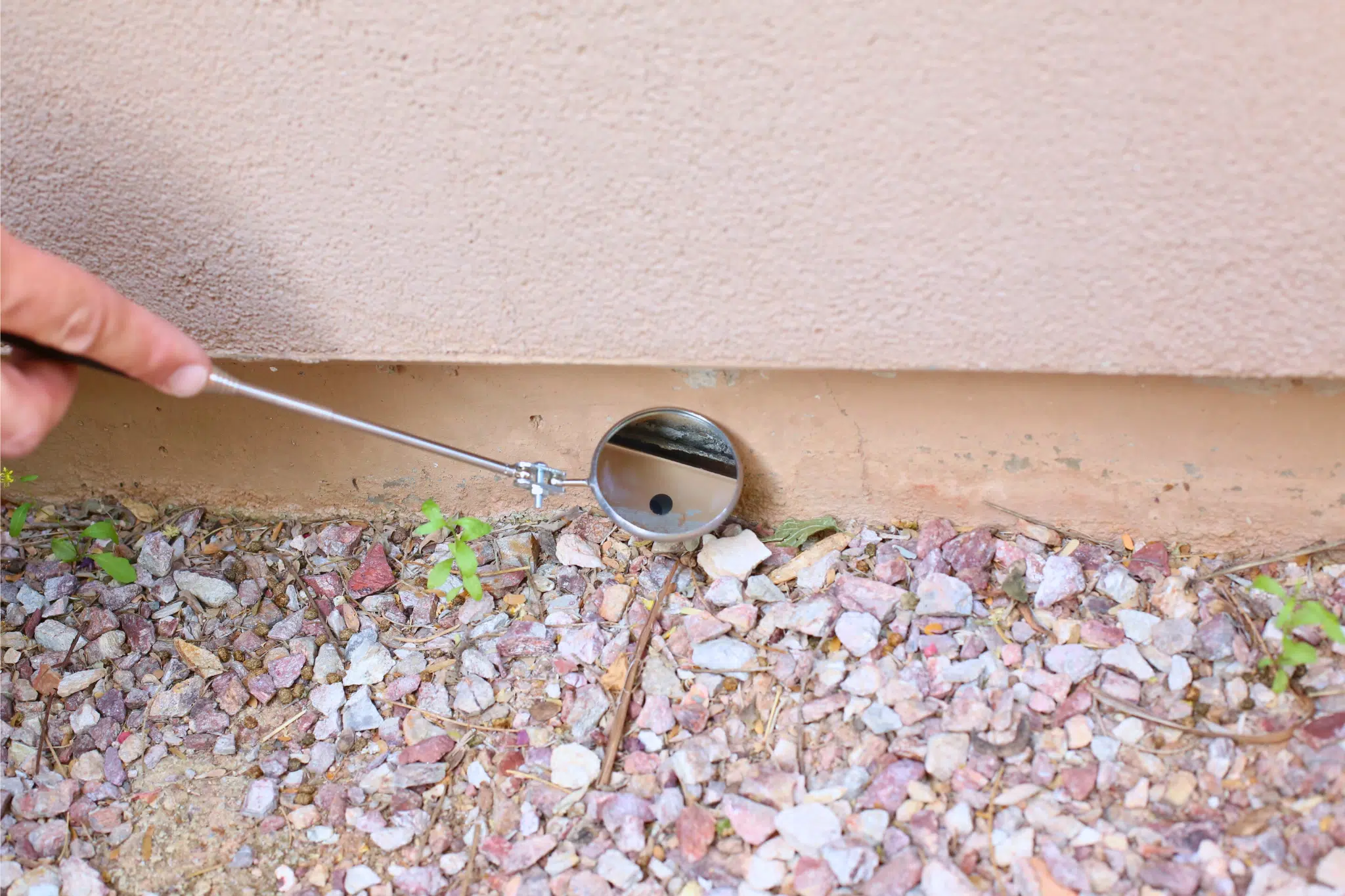
What Happens With Homes In Winter
Homes are dynamic systems. Seasonal changes affect how air moves, how materials behave, and how accessible interior spaces become.
Air Pressure Patterns Become Clearer
Heating systems create predictable airflow. Warm air rises and exits through upper areas of the structure, drawing exterior air inward through lower gaps and penetrations. These pressure pathways are critical to understanding how scorpions and other pests move through a home.
This level of evaluation goes far beyond visual sealing or perimeter treatment.
Materials Shift & Reveal Access Points
Stucco interfaces, expansion joints, trim lines, and utility penetrations respond to temperature changes. In winter, many access points become easier to identify and correct before seasonal pressure increases.
This is not cosmetic sealing, it is performance-based correction.
Protected Interior Spaces Gain Importance
Wall voids, plumbing chases, slab-to-wall transitions, and attic bypasses provide stable conditions during cooler months. These areas influence where scorpions remain positioned as temperatures rise later in the year.
Why Winter Is An Effective Time To Strengthen a Home
Winter provides favorable conditions for preventive correction at a structural level.
When barrier integrity is addressed during cooler months:
- Access pathways are reduced
- Pressure-driven entry is limited
- The home performs more predictably year-round
Homes evaluated and sealed using building-science principles will experience less scorpion pressure during peak seasons and require fewer reactive interventions. Scorpions are curable and preventable with the correct, science based strategies.
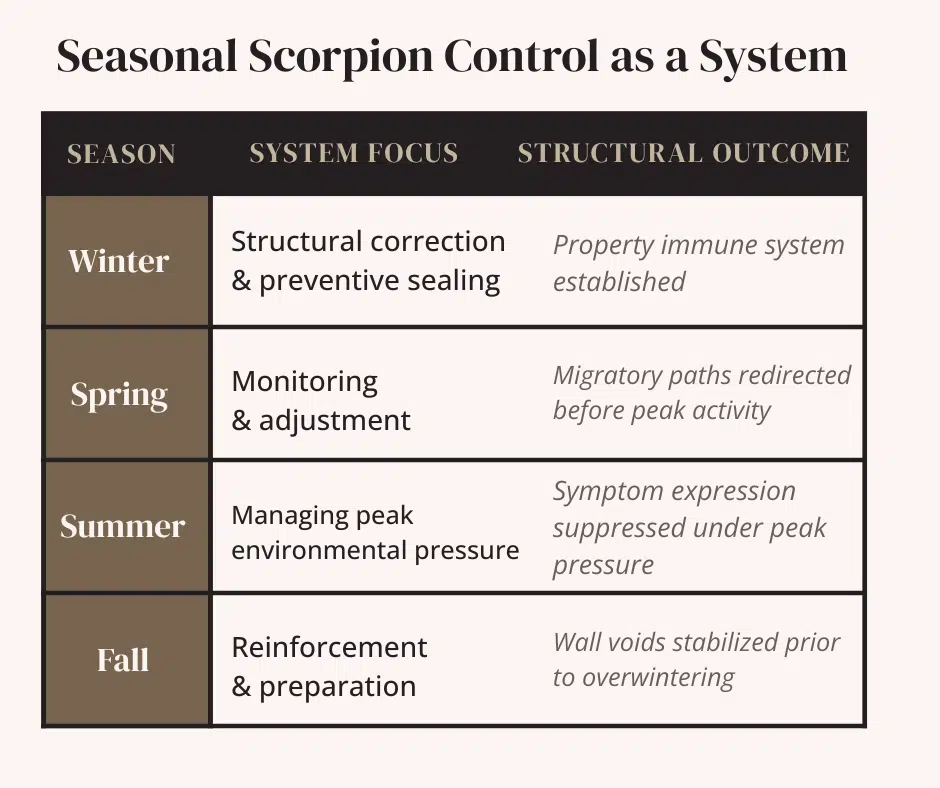
Seasonal Scorpion Control Works As a System
Effective scorpion control is not a single service or treatment. It functions as a system that adjusts throughout the year.
- Winter: Structural correction and preventive sealing, build the property’s immune system.
- Spring: Monitoring and adjustment, change the migratory path
- Summer: Managing peak environmental pressure, suppress the symptoms
- Fall: Reinforcement and preparation, prevent scorpions from wintering down in the wall voids
When the structure is corrected early, each subsequent phase becomes more effective.
The Bottom Line
Scorpion control works best when it is approached as a building performance issue, not a seasonal pest reaction.
Cooler months provide the most favorable conditions to identify vulnerabilities, correct access points, and strengthen barrier integrity before environmental pressure increases.
Homes that address these factors early experience more consistent results across all seasons and long-term protection that cannot be achieved through pest control or contractor-grade sealing alone.
About Seal Out Scorpions®
Seal Out Scorpions is led by Georgia A. Clubb, Advanced Scorpion Specialist, together with William L. Clubb and Michael C. Golleher — Certified Building Analysts and Envelope Professionals through the Building Performance Institute, with additional Building Science Certificates and studies in Urban & Industrial IPM through Purdue University. Their team includes licensed pest management and sealing specialists who pioneered Building Performance Sealing to solve scorpion problems at the structural level.