









Why Are There So Many Scorpions This Year – And What Could Happen This Fall?
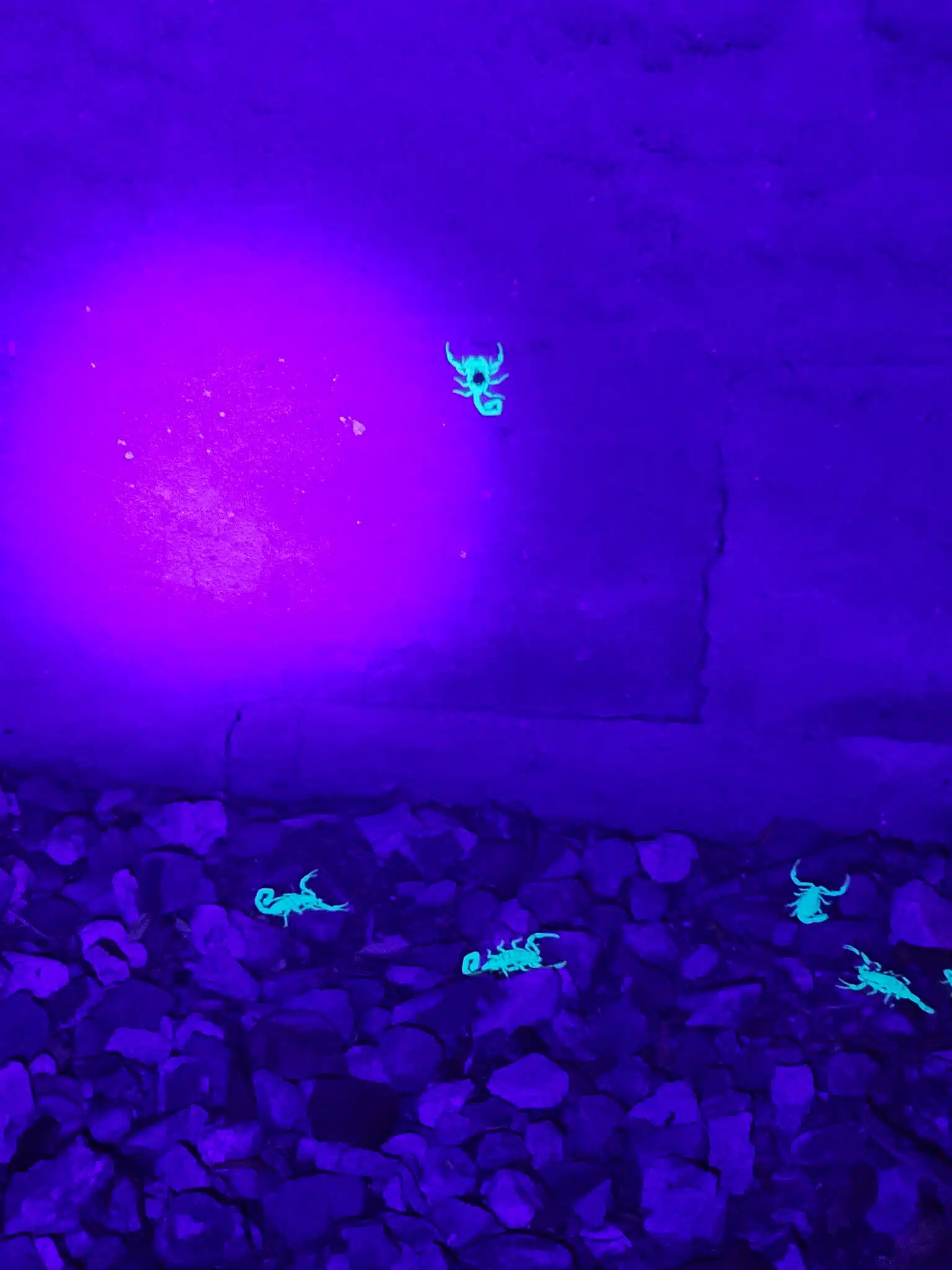
If it seems like there have been more scorpions, crickets and other insects around Phoenix this year, you aren’t the only one noticing it.
At Seal Out Scorpions, our technicians spend thousands of hours each year working in and around Valley homes. We inspect structures during the day, conduct scorpion searches at night, perform pest management and Building Performance Sealing, and talk with homeowners every day about what they are seeing.
From that field perspective, 2026 has been an unusually difficult scorpion season.
But does that mean Arizona actually has more scorpions?
We don’t know that.
What we do know is that Phoenix has experienced an extraordinary sequence of weather events beginning in Fall 2025. Scorpions and the insects they prey upon are ectothermic animals whose activity, water balance, metabolism and shelter selection are influenced by their surrounding environment.
The important question may therefore be bigger than simply how many scorpions exist:
Have the environmental conditions of the past year created greater pest pressure around our homes, and more opportunities for scorpions to encounter the structures we live in?
There are some compelling reasons to investigate that question.
It Started With the Wettest Fall in Phoenix History
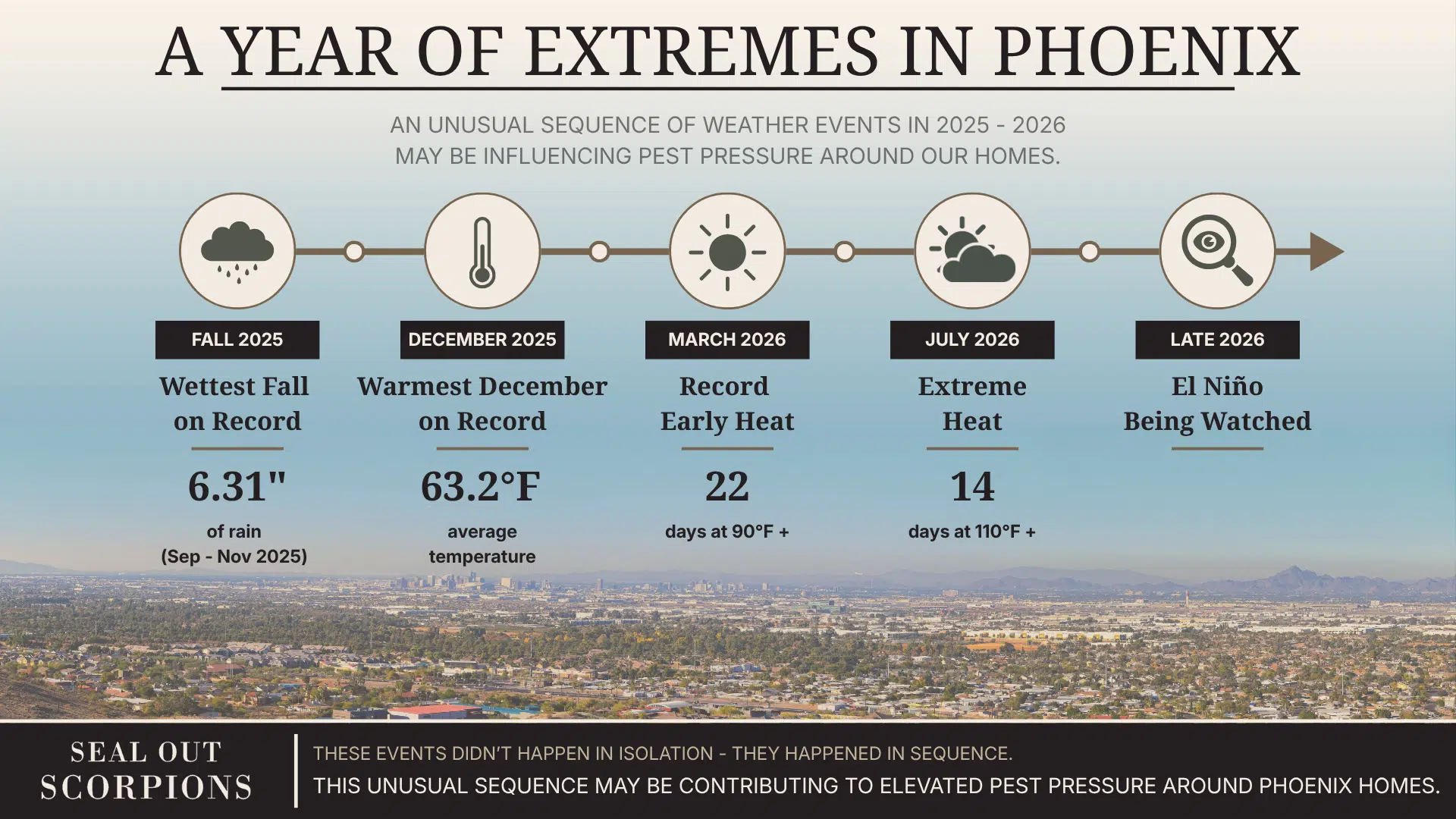
Phoenix received 6.31 inches of rain from September through November 2025, making it the wettest meteorological fall recorded at Phoenix Sky Harbor and surpassing the previous record set in 1939.
To put that into perspective, Phoenix’s normal annual rainfall is only a little over seven inches.
The National Weather Service documented an especially dramatic transition beginning in late September. A September 25-27 storm produced widespread heavy rainfall and flash flooding, including 1.64 inches at Sky Harbor in a single day. October followed with 3.26 inches, making it the third-wettest October on record.
That much water doesn’t just change the weather.
It changes an ecosystem.
Moisture affects vegetation, soil conditions and the countless arthropods living throughout our landscapes. Crickets, cockroaches, beetles and other arthropods are also potential prey for scorpions.
That doesn’t allow us to say, “The rain caused more scorpions.”
Ecology is rarely that simple.
But an unusually wet desert can alter the food, moisture and harborage conditions surrounding a scorpion population.
And then the weather changed again.
Winter Never Delivered Much of a Reset
Arizona bark scorpions (Centruroides sculpturatus) don’t disappear when summer ends.
University of Arizona Cooperative Extension reports that bark scorpions can remain active through much of the year in the low desert, with nighttime temperatures above approximately 70°F being particularly favorable for activity. During colder periods their activity decreases, and groups can occupy protected winter shelters, or hibernacula.
The winter following Phoenix’s historic rainfall was unusually warm.
In fact, the National Weather Service ranked December 2025 as Phoenix’s warmest December on record, with an average temperature 7.4°F above normal. November was also unusually warm.
That leads to an interesting biological question:
What happens when an exceptionally wet fall is followed by an exceptionally warm beginning to winter?
We shouldn’t pretend the answer is already known.
But from a pest-management perspective, it is exactly the type of environmental sequence worth studying.
Then March Behaved More Like Summer
Spring didn’t gradually arrive in Phoenix in 2026.
It exploded.
According to the National Weather Service, March 2026 averaged 12.5°F above normal. Phoenix reached at least 90°F on 22 days, compared with a normal of just 2.1 such days.
Then Phoenix reached 105°F on March 19, 20 and 21, establishing a new March record. The previous earliest 100°F day in Phoenix had historically occurred on March 26.
For humans, it was extraordinary weather.
For ectothermic animals, temperature has another significance.
Unlike humans, scorpions don’t internally regulate body temperature in the same way mammals do. Their physiology and behavior are strongly influenced by environmental temperature. As conditions change, so can activity periods, metabolic demands and shelter selection.
Again, we cannot say that the March heat “created” Arizona’s 2026 scorpion season.
But it potentially changed the timetable.
At Seal Out Scorpions, we think that distinction matters.
Scorpions Are Also Fighting a Water-Balance Problem
Scorpions are remarkably adapted to desert environments, but desert adaptation does not make an animal immune to water loss.
Their exoskeleton and its waxy cuticular lipids help control water loss. Scientific research involving Centruroides sculpturatus has examined the relationship between temperature and cuticular permeability, the movement of water through that protective exterior.
That gives us another way to think about Arizona’s weather.
A scorpion isn’t simply responding to temperature.
It is simultaneously interacting with temperature, relative humidity, available moisture, prey, shelter, predators and the thermal characteristics of the surfaces around it.
A block wall heated by the Arizona sun is one environment.
The protected interior of that block wall is another.
Irrigated landscaping is another.
And the air conditioned house sitting a few feet away is another.
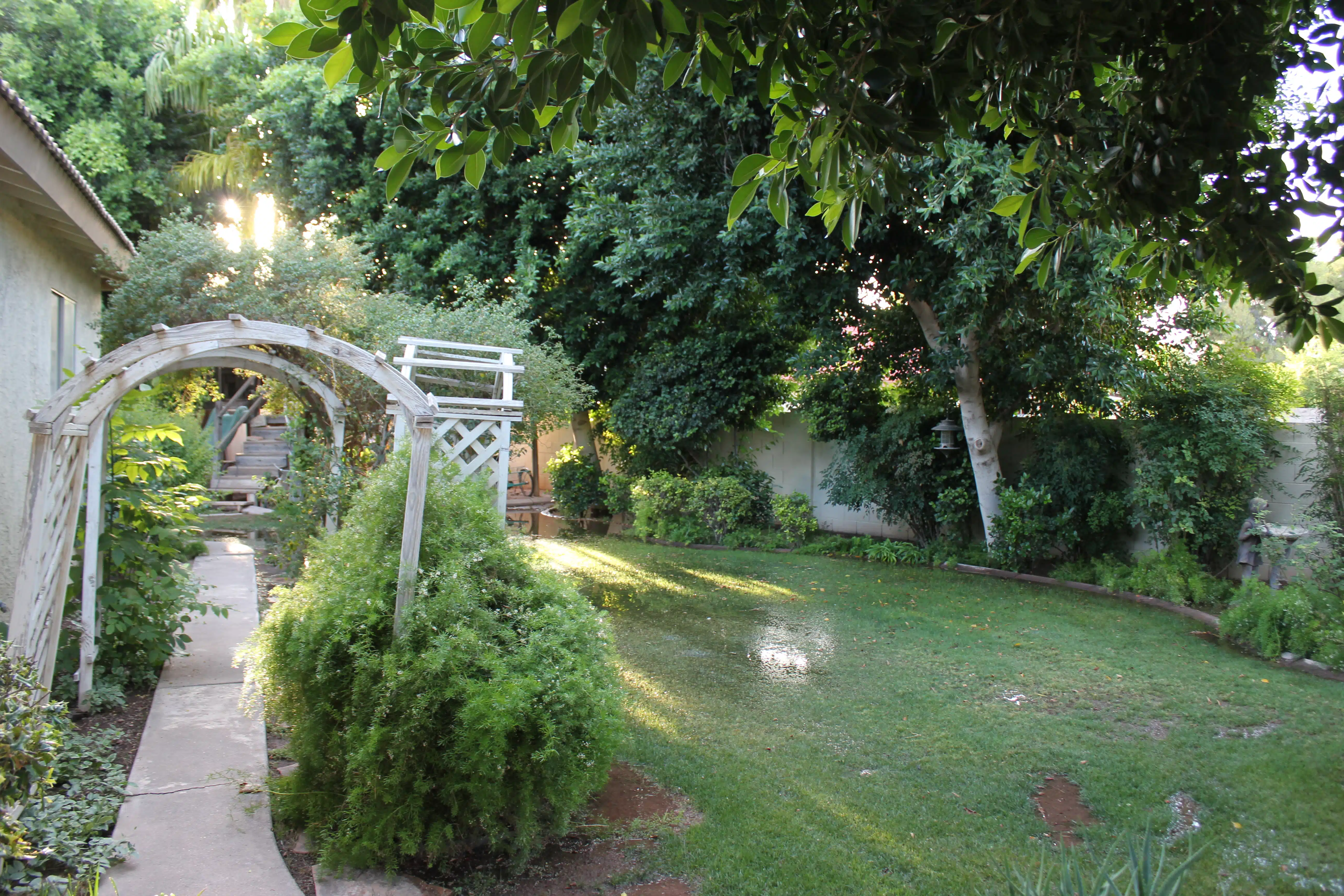
This is where pest biology begins interacting with building science.
The House Is Part of the Ecosystem
Arizona bark scorpions are particularly well suited to the built environment.
University of Arizona researchers and other published work describe bark scorpions using cracks, crevices, block walls and other protected spaces associated with structures. University of Arizona Extension specifically notes their tendency to occupy protected spaces during colder periods.
That matters because a Phoenix home is not an airtight box.
Every home has pathways connecting exterior and interior environments.
There are construction joints, utility penetrations, wall systems, doors, plumbing penetrations, electrical penetrations, roof transitions and hundreds of smaller openings created during construction and through decades of repairs and modifications. Essentially, these small openings create micro airleaks that scorpions and other pests can detect and use as pathways.
Many are insignificant from the perspective of conventional weatherization.
They may not be insignificant to a scorpion.
This is why Seal Out Scorpions approach a scorpion problem differently.
We look at the Pest Barrier Integrity System.
The basic principle is simple:
The strength of the home’s pest barrier must be greater than the pest pressure being exerted against it.
The barrier system comprises the homes building seals, the pest management barriers, landscape features and a resident’s strategies for control.
When environmental pressure increases, weaknesses that may have gone unnoticed for years can suddenly become significantly relevant.
Building Performance Sealing Is Different From Pest Control or Contracting Caulking and Sealing Services.
Traditional pest exclusion often focuses on obvious openings.
Building Performance Sealing process looks at the structure as a system, its mechanical and structural ventilation, and the building and integrated pest management science for residential scorpion control.
We first evaluate how the interior conditions interact with the exterior conditions or the building envelope. We identify hundreds of the small pathways that can allow scorpions and other arthropods to move through the structure, from the outside to the indoor living spaces from ceiling to floor and all in between.
That distinction becomes particularly important during periods of elevated pest pressure and temperatures with increased air conditioned spaces.
A home does not necessarily develop a new access point because the weather changed.
Instead, the scorpion pressure against existing vulnerabilities may have changed.
That’s an important concept.
A barrier that appeared adequate under low scorpion pressure may perform very differently when surrounding pest activity increases.
And Then There Are the Crickets and Moths
One of the most noticeable features of 2026 has been the amount of other insect activity we’ve encountered.
Crickets, moths and other insects are particularly important because scorpions are predators (although they are also cannibalistic).
A property isn’t just supporting scorpions. It is supporting a food web.
Landscape moisture, vegetation, organic debris, artificial turf, block walls, irrigation systems, lighting and other features can influence arthropod activity around a property.
If prey pressure increases, that becomes another variable in the equation.
This is why treating only the scorpion can miss part of the problem.
Effective Integrated Pest Management asks a broader question:
Why is this property supporting the pest pressure we’re seeing and how can the insects be controlled better without flushing or routing scorpions into the home?
July Adds an Important Lesson About Phoenix Weather
There has been discussion that July 2026 was one of Phoenix’s wettest Julys in some time. Official National Weather Service records don’t necessarily support that conclusion for Phoenix Sky Harbor.
Sky Harbor received 0.46 inches during July, approximately half its normal 0.91 inches. At the same time, July was extremely hot: the average maximum temperature was 108.3°F, and Phoenix experienced 14 days at or above 110°F.
That doesn’t mean individual Valley neighborhoods weren’t hammered by monsoon storms.
They were.
And this illustrates an important problem when studying scorpions in metropolitan Phoenix:
Scorpions don’t experience weather at Sky Harbor Airport. They experience the microclimate of a particular property and neighborhood.
One neighborhood may receive a violent storm while another several miles away remains nearly dry.
One property may have saturated artificial turf, irrigated block walls and dense vegetation while the property next door is comparatively dry.
For pest research, those differences matter.
Now El Niño Enters the Picture
The next chapter is already developing.
NOAA’s Climate Prediction Center currently has an El Niño Advisory in effect. El Niño is expected to strengthen through the end of 2026, with NOAA reporting a 97% chance that it persists through early Spring 2027.
You may hear the term “Super El Niño.”
That’s a popular description rather than NOAA’s formal classification, so we prefer to be more precise.
Current forecasts indicate the potential for a very strong El Niño event.
What that ultimately means for rainfall in one Phoenix neighborhood, or for scorpions at one particular home, cannot be predicted with certainty.
El Niño changes probabilities. It doesn’t write the weather forecast months in advance.
And it certainly doesn’t allow a claim that Arizona will automatically have “more scorpions” next year.
But it gives us another environmental variable worth watching and preparing for.
So Are There Actually More Scorpions in 2026?
Maybe.
But more sightings do not automatically prove a larger population.
More sightings could result from a larger population.
They could also result from increased movement, changes in seasonal activity, changes in prey distribution, changes in shelter selection, greater survival, localized environmental displacement, or some combination of these factors.
That’s why Seal Out Scorpions is careful about the distinction.
As a Regional Specialist for scorpions and complex residential pest problems, we don’t believe the answer to every scorpion sighting is simply more pesticide.
Pesticides, prescriptive and strategic, are an important tool.
But they are one component of a larger Pest Barrier Integrity System that can include Building Performance Sealing; advanced scorpion and general pest control; landscape and environmental corrections or strategic awareness; monitoring, and homeowner education.
The goal is to understand the pressure outside, the integrity of the barrier between, and the evidence appearing inside.
What We’re Watching Next
Fall may tell us a great deal.
Will scorpion activity decline normally as nighttime temperatures fall?
Will prey populations remain unusually high?
Will warm conditions extend activity later into the year?
How will scorpions respond if El Niño produces a wetter winter?
And after the extraordinary environmental sequence beginning in Fall 2025, what will Spring 2027 look like?
Those are questions, not conclusions.
And they’re questions we’ll be studying.
At Seal Out Scorpions, more than two decades of working with Arizona and Southwestern homes has taught us that serious scorpion problems are not explained by one variable.
Weather changes pest pressure. Landscape changes pest pressure. Prey changes pest pressure. Other variables are at play. The structure determines how much of that pressure and the variables allow scorpions and other pests to reach the living space.
That is why we don’t simply look for a scorpion.
We look at the system surrounding it.
By Georgia A. Clubb, Advanced Scorpion Specialist, Founder of Seal Out Scorpions®
About Georgia Clubb & Seal Out Scorpions®
Seal Out Scorpions is led by Georgia A. Clubb, Advanced Scorpion Specialist, together with William L. Clubb and Michael C. Golleher — Certified Building Analysts and Envelope Professionals through the Building Performance Institute, with additional Building Science Certificates and studies in Urban & Industrial IPM through Purdue University. Their team includes licensed pest management and sealing specialists who pioneered Building Performance Sealing to solve scorpion problems at the structural level.