






Building Performance and Scorpion Risk Management
A Systems-Based Approach to Scorpion and General Pest Risk Reduction
Most pest control programs focus on the pest.
Most sealing programs focus on visible openings.
Most homeowners focus on the scorpion they found yesterday.
None of those perspectives are wrong.
They are simply incomplete.
Over more than two decades, Seal Out Scorpions has observed that scorpion encounters are rarely the result of a single factor. Instead, they are usually the outcome of multiple environmental, structural, biological, and behavioral conditions interacting simultaneously.
This observation led to the development of a systems-based approach we call Building Performance and Scorpion Risk Management.
The framework supporting this approach is called the Pest Barrier Integrity System (PBIS).
PBIS is built on a simple principle:
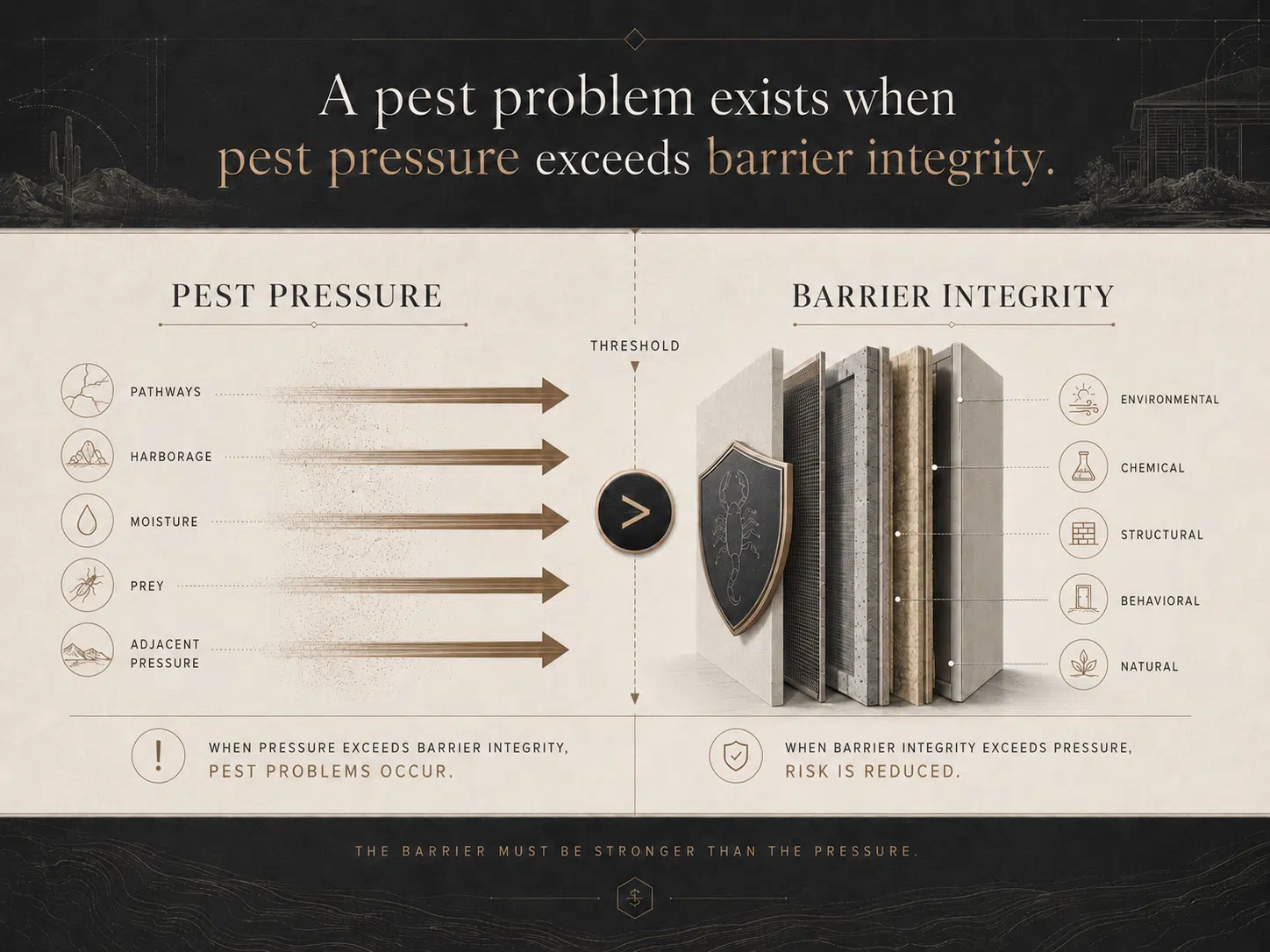
A pest problem exists when pest pressure exceeds barrier integrity.
In simple terms:
The barrier must be stronger than the pressure.
The Limitation of Single-Solution Thinking
Scorpion management is often approached through a single solution.
Examples include:
- Applying pesticides.
- Sealing visible openings.
- Removing landscape features.
- Using repellents.
- Performing blacklight searches.
Each may provide value.
None fully explains why one property experiences repeated activity while another nearby property does not.
The problem is that scorpions are not random.
Scorpions respond to systems.
Understanding the system is often more important than reacting to the individual encounter.
Scorpion Biology and Environmental Relationships
Research conducted by scientists including Gary Polis and William Brownell significantly expanded our understanding of scorpion ecology, behavior, habitat utilization, and environmental relationships.
Scorpions commonly respond to:
- Structure
- Harborage
- Moisture
- Airflow
- Prey availability
- Temperature
- Seasonal weather patterns
- Habitat connectivity
Like water follows pathways through a landscape, scorpions often follow pathways through an environment.
A scorpion discovered inside a home is frequently the visible result of conditions that developed long before the encounter occurred.
The scorpion is often the symptom.
The system created the opportunity.
Pest Pressure
Most homeowners view pest activity as a property problem.
In many situations, it is a neighborhood pressure problem first.
Scorpions do not recognize property lines.
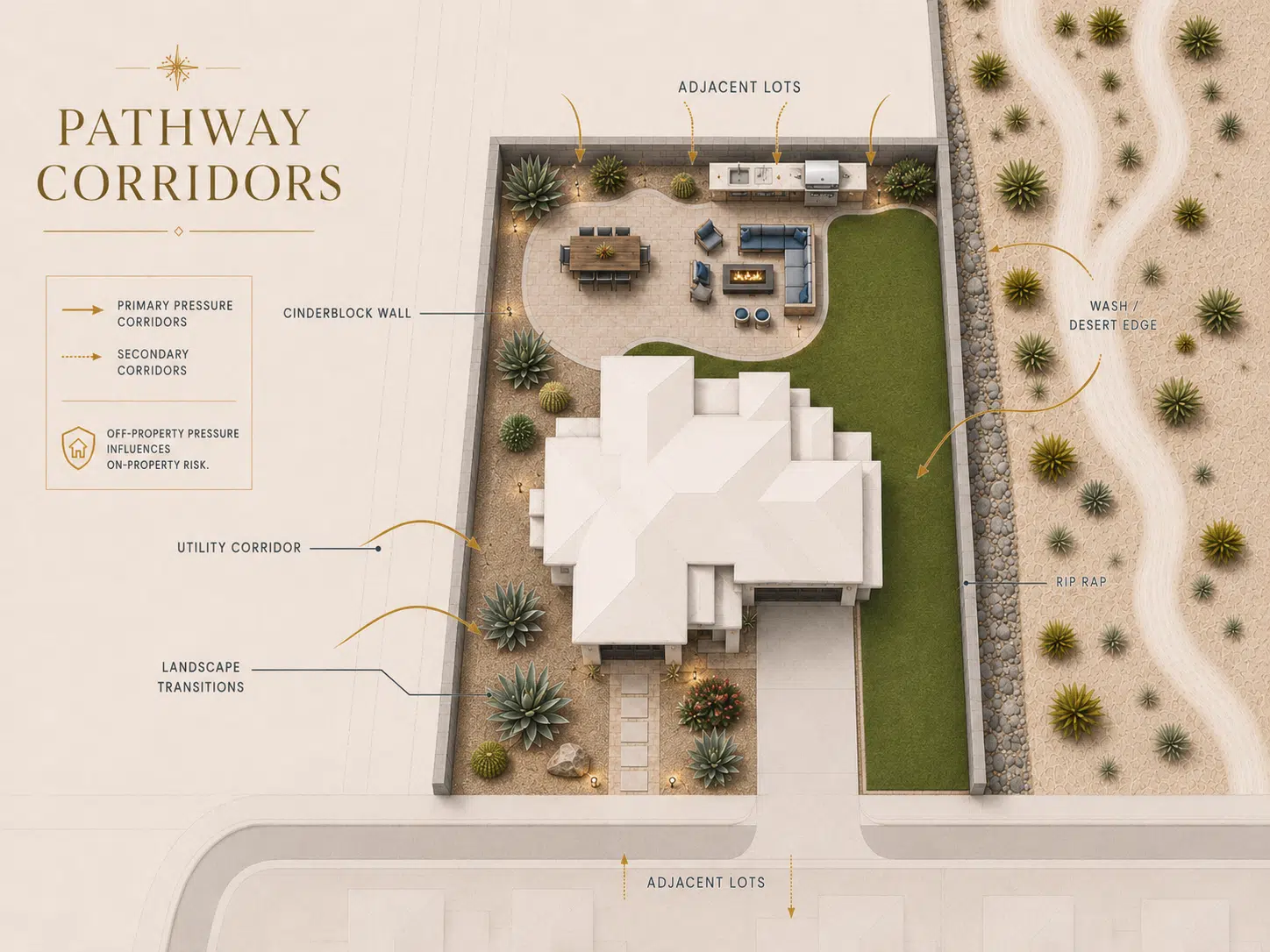
Pressure can originate from:
- Adjacent properties
- Vacant lots
- Washes
- Desert interfaces
- Rip rap systems
- Cinderblock walls
- Utility corridors
- Landscape transitions
- Construction activity
We describe these influences as pathway corridors.
Pathway corridors function much like roads.
They influence movement.
They influence pressure.
They influence encounters.
A property may experience activity not because it produces scorpions, but because it exists within the flow of scorpion movement.
Understanding pressure requires understanding both the property and the surrounding environment.
Pest Barrier Integrity
Pest Barrier Integrity represents the ability of a property to resist, redirect, reduce, or recover from pest pressure.
A strong barrier system is not a single product.
It is not a single treatment.
It is not a single service.
It is a collection of interacting layers.
These layers often include:
Environmental Barriers
- Moisture management
- Landscape management
- Harborage reduction
- Irrigation practices
- Environmental modification
Chemical Barriers
Very specific Tier 1 professional pest management products and application methods designed to reduce pest pressure.
These products can be highly valuable if used in a systematic approach.
However, they generally reduce pressure rather than eliminate pathways.
Structural Barriers
Building Performance Sealing® and exclusion methods, by highly skilled and certified technician teams, are designed to reduce pest movement into the structure.
Behavioral Barriers
Homeowner education, monitoring, participation, and expectations, and ongoing support.
Natural Barriers
Physical exclusion, environmental modification, non-toxic deterrents, and habitat management strategies.
The strongest barrier systems are rarely dependent upon a single layer.
The strongest systems use multiple layers working together.
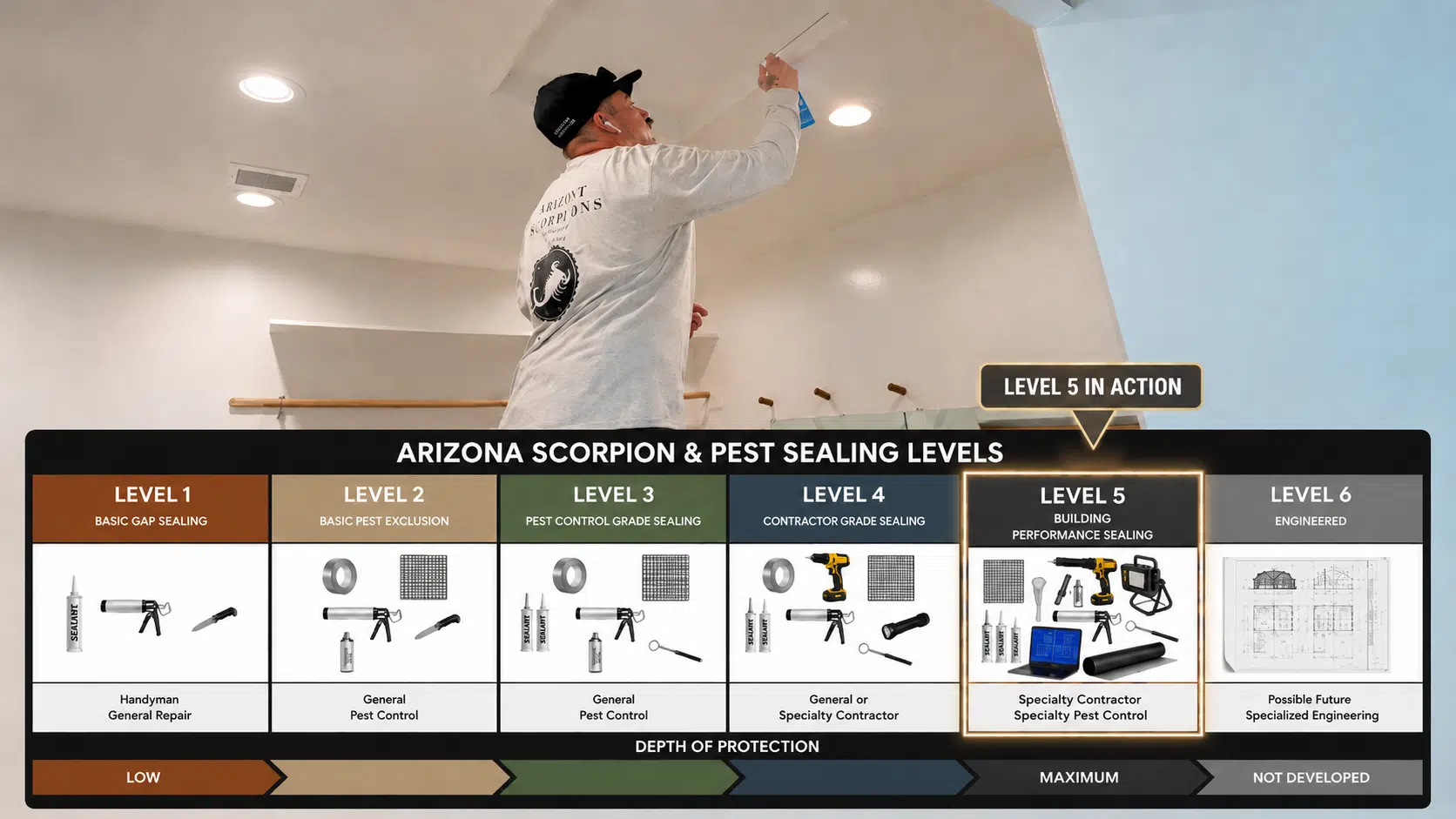
Contractor and Pest Control Grade Sealing vs Building Performance Sealing®
Most structures already contain sealants.
The question is not whether a home is sealed.
The question is:
Sealed for what purpose?
Builders typically seal structures to satisfy:
- Construction requirements
- Weatherization requirements
- Energy efficiency requirements
- Code requirements
This is often referred to as contractor-grade sealing.
Contractor-grade sealing serves important purposes.
However, it is generally not designed specifically to address pest movement.
Many homeowners hire various pest control companies to seal visible gaps. However, pest control services do not understand structural and mechanical ventilation or building science.
Building Performance Sealing approaches the structure differently.
The service addresses hundreds of micro-air leaks that are visible and invisible to most home owners, contractors and pest control technicians.
- Utility penetrations
- Structural transitions
- Air leakage pathways
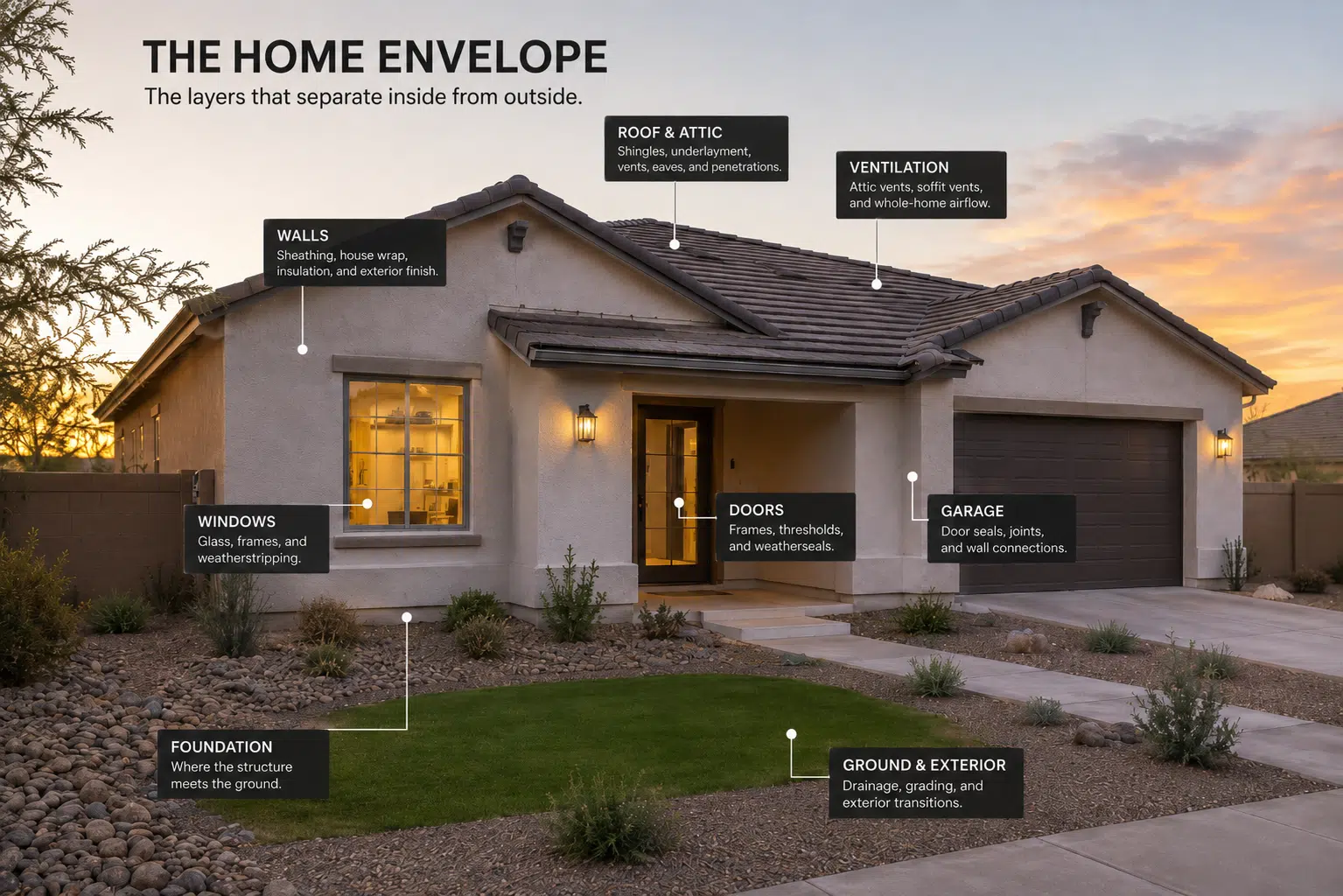
- Building envelope vulnerabilities
- Construction gaps
- Expansion joints
- Micro entry opportunities
Many pathways considered insignificant from a construction perspective are highly significant from a pest movement perspective.
The objective is not to apply more sealant.
The objective is to improve barrier performance.
Building Performance and Building Science
Building Performance principles have traditionally been used to evaluate comfort, efficiency, durability, and indoor environmental quality.
Many of the same factors influencing building performance also heavily influence pest movement.
Examples include:
- Air leakage
- Pressure relationships
- Building envelope performance
- Thermal movement
- Structural transitions
- Utility penetrations
As Building Performance Institute (BPI) trained professionals and a certified Gold Star Contractor, we evaluate structures as systems rather than collections of individual components.
This perspective frequently reveals vulnerabilities invisible to traditional pest management approaches.
Macro-Weatherization and Micro-Weatherization
Traditional weatherization often focuses on larger energy-related improvements.
Examples include:
- Attic insulation
- Duct leakage
- Window performance
- Major building envelope improvements
This can be viewed as macro-weatherization.
Scorpion and pest control sealing must operate at a smaller scale.
This can be viewed as micro-weatherization.
These openings have a significant impact on pest control and energy savings.
From a scorpion’s perspective, a pathway only needs to be large enough to permit movement, often the thickness of a credit card.
Root Cause Analysis vs Symptom Management
A useful comparison can be made to healthcare.
Medications often reduce symptoms.
Good healthcare also seeks to understand underlying causes.
Professional pest management products, which can be viewed as “medications” serve a similar role.
They can reduce pressure.
They can reduce activity.
They can improve conditions.
However, products alone do not necessarily explain:
- Why pests are present.
- How pests are entering.
- Why activity persists.
- What environmental conditions support movement.
- What structural vulnerabilities exist.
The strongest programs combine symptom management with root cause analysis.
Weather, Materials, and Performance
Environmental conditions influence both pest behavior and barrier performance.
Important variables include:
- Heat
- Humidity
- Seasonal transitions
- Monsoon activity
- Surface temperatures
- Expansion and contraction
- Cure times
- Adhesion performance
- UV exposure
Weather affects pests.
Weather affects structures.
Weather affects materials.
Effective risk management requires understanding all three of the sciences.
The Weight of Scorpions
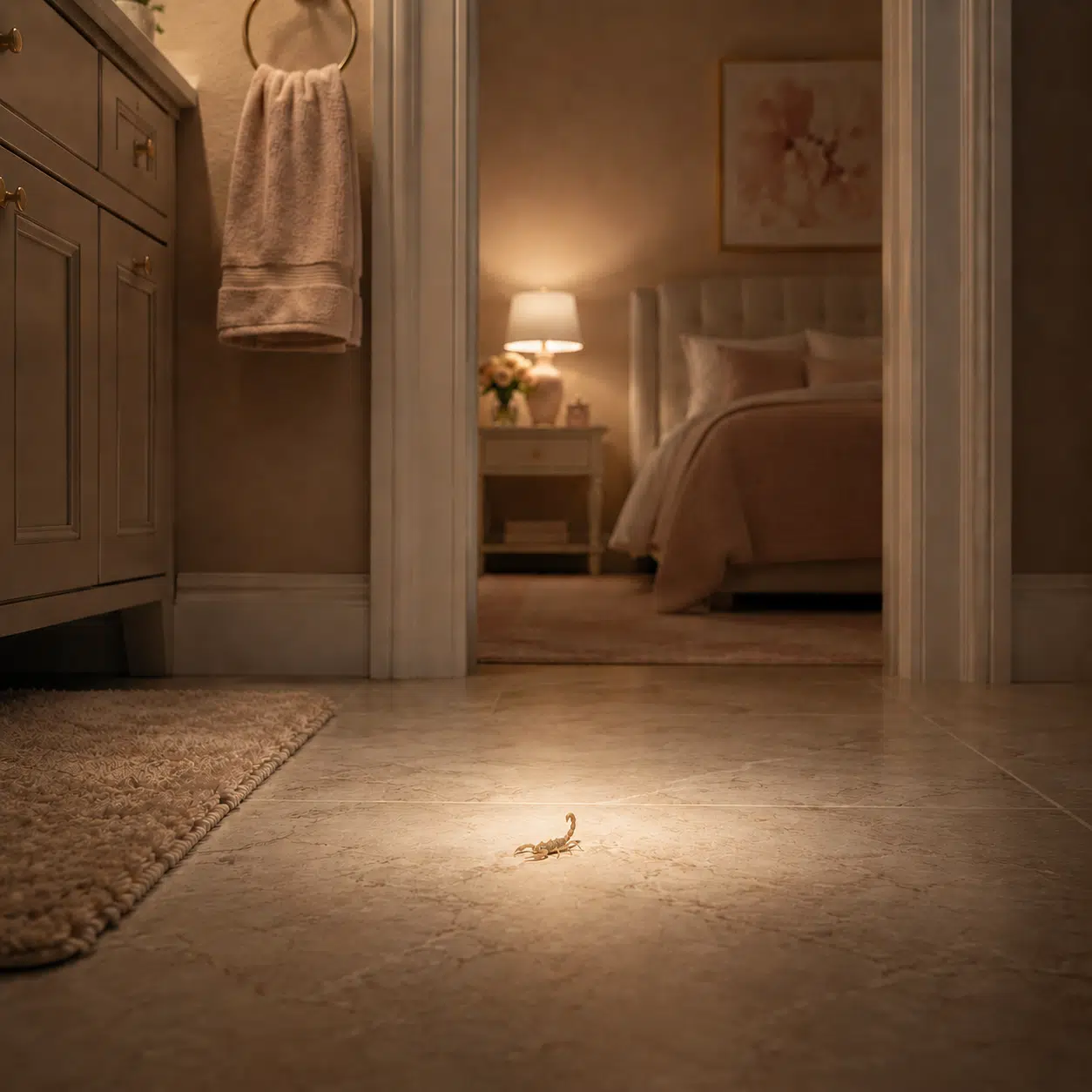
Most homeowners do not call because they found a scorpion.
They call because of what the scorpion represents.
The questions.
The uncertainty.
The concern.
The responsibility.
The decisions.
The research.
The monitoring.
The fear.
The burden is often greater than the pest itself.
One of the primary goals of Building Performance and Scorpion Risk Management is to reduce that burden.
The homeowner transfers uncertainty to a professional system capable of evaluating pressure, pathways, barriers, and risk.
The objective is not simply pest reduction.
The objective is confidence and safety, especially in the home.
Scientific and Professional Foundations
Building Performance and Scorpion Risk Management draws from multiple disciplines including:
- Scorpion Biology
- Integrated Pest Management (IPM)
- Building Science
- Building Performance Institute (BPI) methodologies
- Building Analyst principles
- Material Science
- Structural Exclusion Practices
- Environmental Risk Management
- Weather, Seasonal and Moon Phase Factors
- Human Risk Perception
- Consumer Decision Theory
- And More
The Pest Barrier Integrity System represents the integration of these disciplines into a unified framework for understanding and reducing pest risk.
Conclusion
Scorpions are rarely just a scorpion problem.
They are often a pressure problem.
A pathway problem.
A barrier problem.
A risk management problem.
The objective is not simply to kill scorpions and pests.
The objective is to create a property where the barrier is stronger than the pressure.
That is the Pest Barrier Integrity System.
That is Building Performance and Scorpion Risk Management.
That is the pursuit of living comfortably and confidently in your home – which is achievable.
By Georgia A. Clubb, Advanced Scorpion Specialist, Founder of Seal Out Scorpions®
About Georgia Clubb & Seal Out Scorpions®
Seal Out Scorpions is led by Georgia A. Clubb, Advanced Scorpion Specialist, together with William L. Clubb and Michael C. Golleher — Certified Building Analysts and Envelope Professionals through the Building Performance Institute, with additional Building Science Certificates and studies in Urban & Industrial IPM through Purdue University. Their team includes licensed pest management and sealing specialists who pioneered Building Performance Sealing to solve scorpion problems at the structural level.