








Generic Scorpion Control vs. Prescriptive Scorpion Risk Management
Generic recommendations exist in nearly every profession.
Pest control for scorpions is no different and often occurs within the context of general insect pest control.
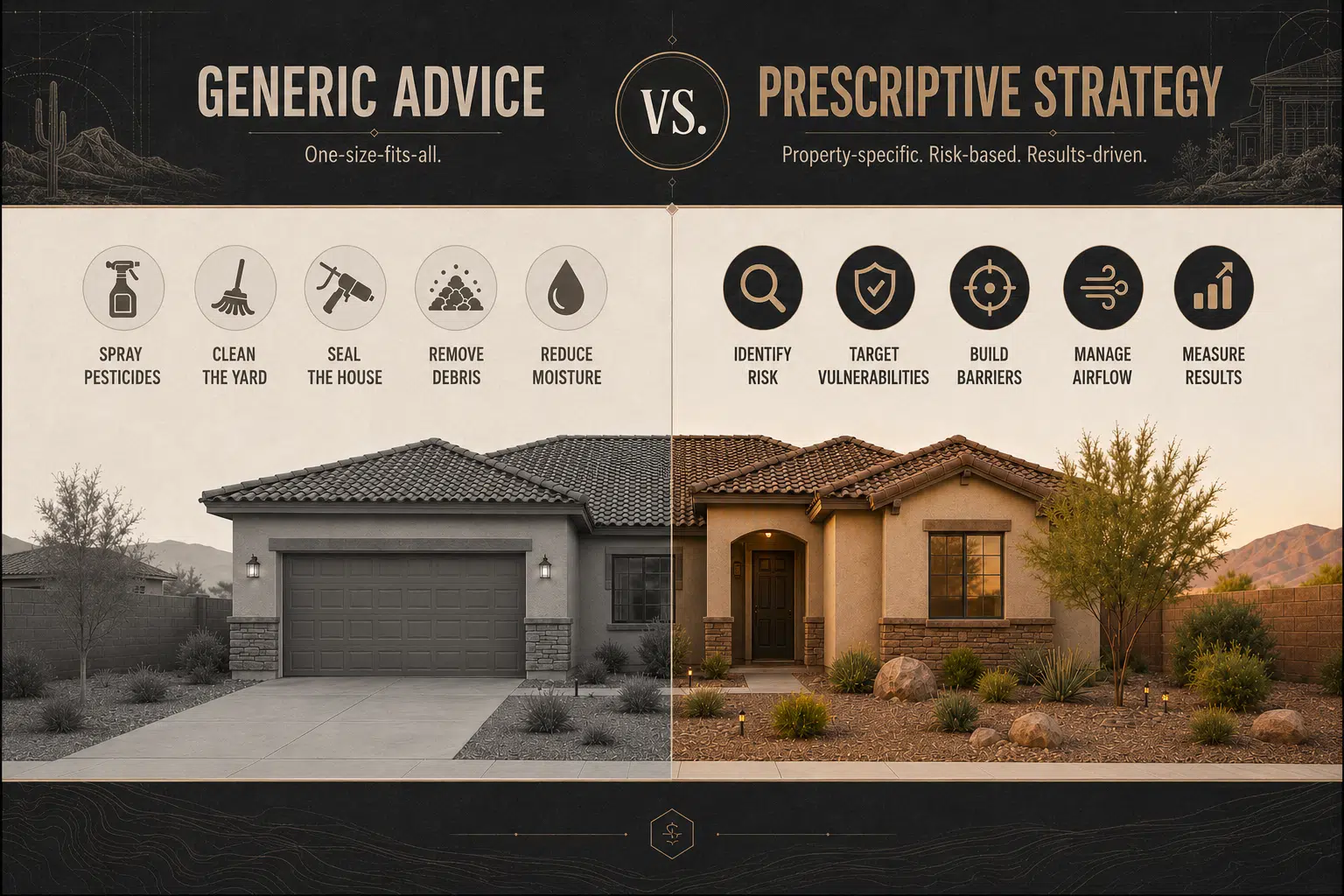
Common recommendations include:
- Seal the house (generic contractor or general pest control grade, building performance sealing, and what’s the difference?)
- Keep the yard clean (what if it already is?)
- Remove debris and clutter (what if there is none?)
- Reduce moisture (what if one can’t with a pool, irrigation, or next to a wash?)
- Apply pesticides (general broad-spectrum labeled to kill a scorpion, like most are, or something more specific, in a specific manner for a specific property?)
- Use diatomaceous earth (even though it’s not labeled for scorpions and doesn’t seem to work well?)
The recommendations are always necessarily wrong. However, they are generic information without context. They are not prescriptive of order, timing, strategy, dosage, priority, or expected impact that can have both positive and negative effects, and are not well understood by most.
Generic recommendations are designed to apply to just about all situations.
They may help and may even work if the problem is relatively simple.
Complex problems rarely achieve optimal results through generic recommendations alone.
This distinction is important when discussing Arizona bark scorpions, which are an arboreal (tree-climbing) species. They follow structure, moisture gradients, and airflow, which is in abundance on a residential property.
Generic Information vs. Prescriptive Information
There is a distinct difference between a generic approach and prescriptive treatment plans.
Generic information and approaches apply broadly.
Prescriptive information applies specifically to conditions, level, and complexity.
For example:
Generic recommendation:
Seal the house against scorpions and pests. This is handyman, contractor-grade, or pest control-grade sealing. This is typically conducted at any time of the year with little regard to weather patterns and coordination with other strategies.
Prescriptive recommendation:
Identify the vulnerabilities that contribute most to scorpion risk, and prioritize corrections based on likely impact and on how scorpions will be both blocked and rerouted. This would be part of a Pest Barrier Integrity system using Building Performance Sealing methodology, with specialized skill sets focused on first understanding air pressure and micro-air leaks left by contractors and builders. This would include understanding building science, building product specifications, the impact of weather conditions, and how layers of secondary strategies should be prescribed.
Those are not the same recommendations, nor will they have the same outcome.
One is a category and a generic work.
The other is a strategy that involves methodical work toward a specific outcome.
Arizona homes contain hundreds or more micro air leaks and vulnerabilities. Some may contribute little risk and may be required as part of a natural ventilation system, such as attic space. Many invisible and often unknown factors contribute significantly to risk. Some may never be utilized by a scorpion. Others represent primary pathways and rerouting networks of travel identified by air pressure and air flow.
The challenge is not knowing that sealing can be beneficial; it has become a more recognized strategy.
The challenge is determining what should be sealed, why, when, and what effect the correction is expected to have on the property. The challenge is who should seal it, especially when there is no specific schooling, training, licensing, or formal industry recognition or standard. Any pest control company not licensed as a contractor may offer the service. Any contractor not licensed in pest management may offer the service. Many handymen may offer the service. Anyone knowing how to use a caulking gun may attempt it. The outcome requires luck and a low scorpion pressure.
The recommendation most people try first is generic.
Many of our clients, by the time they get to us, are now looking for results that often can’t be met unless it’s prescriptive, strategic, and follows a simple rule: The Pest Barriers, both for the yard and house, must be stronger than the neighboring scorpion pressures. That requires Applied Science knowledge, and well-educated, prescriptive knowledge, not generic advice or approach.
Scorpions Are Not Insects
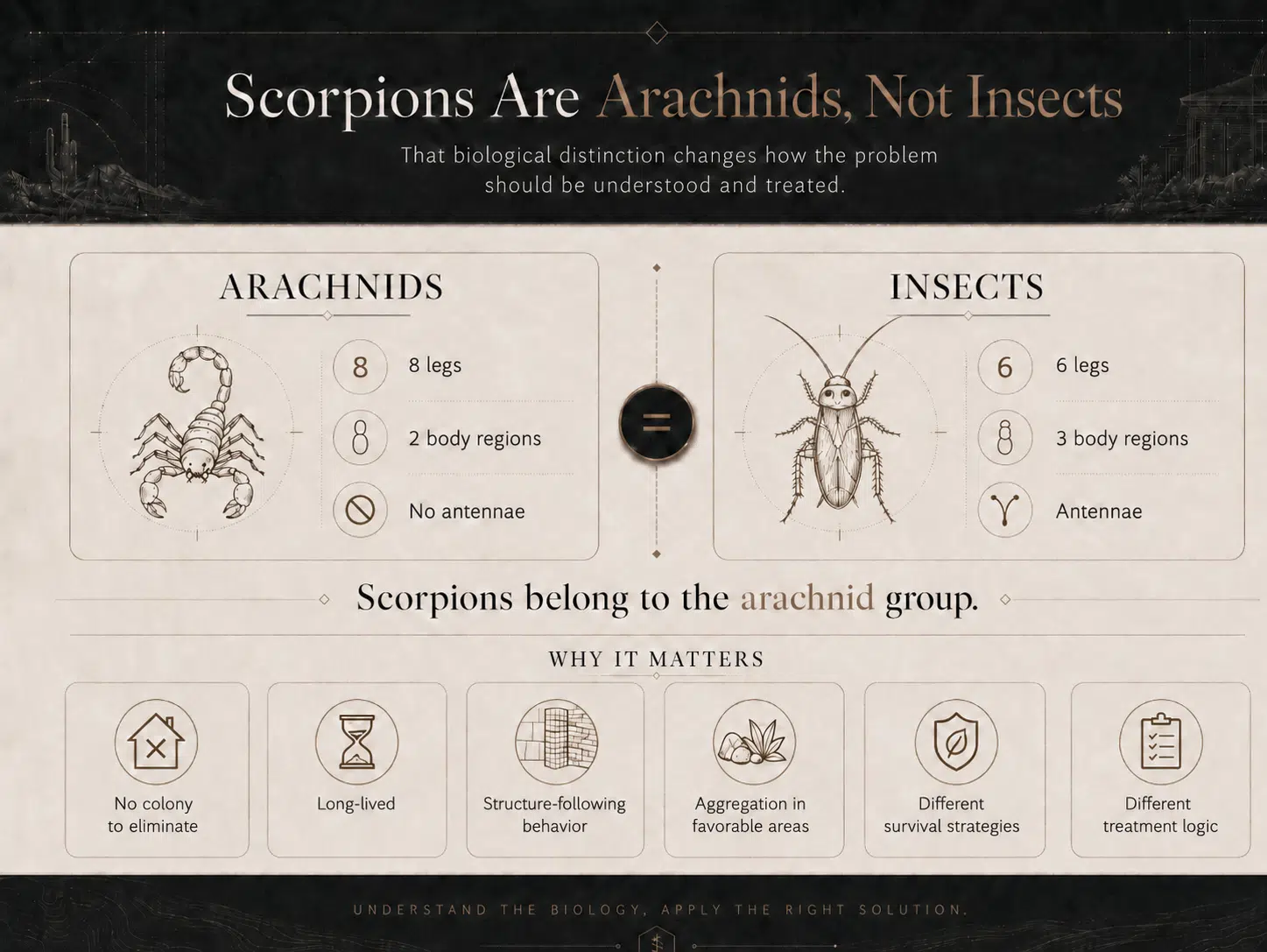
Most scorpion control strategies are based on insect control.
Scorpions are not insects. You can kill an individual with generic insect-control advice. Population control in your yard or around your home is something different.
They are classified as arachnids. They are very long-lived, with behaviors, environmental preferences, survival strategies, and movement patterns that differ significantly from those of many common pests, including spiders.
A cockroach, ant, or spider problem is not solved using the same thought process as a bark scorpion problem.
Scorpions utilize structures, landscapes, and harborage areas differently.
They respond differently to environmental conditions.
They can survive for extended periods under conditions that would challenge many other pests.
They do not have a nest or colony that can be eradicated. They do, however, aggregate in favorable areas.
They interact with structures, moisture, temperature, and environmental conditions in ways that make simplistic recommendations less effective than many expect or understand.
The complexity of the organism often requires a more specific understanding of the varied conditions that allow it to become a threat in our living environment.
Why Generic Recommendations Often Fall Short
Most homeowners who contact Seal Out Scorpions have already attempted some form of scorpion control.
Many have already hired one or more pest control companies.
Many have already implemented common recommendations.
Many have already purchased products marketed or labeled specifically for scorpions.
Many have already sealed portions of their homes with contractor-grade or pest-control-grade sealing methods.
Many have already started with or have cleaned and maintained yards.
Yet scorpions remain present and randomly show up in the house on the floor, ceiling, wall, curtains, in drawers, shoes, and worst of all, furniture or beds.
Many generic recommendations may not have been wrong.
The recommendations are often too simple, incomplete, and without a root cause focus and strategy.
For example, “seal the house” sounds simple.
What does that mean?
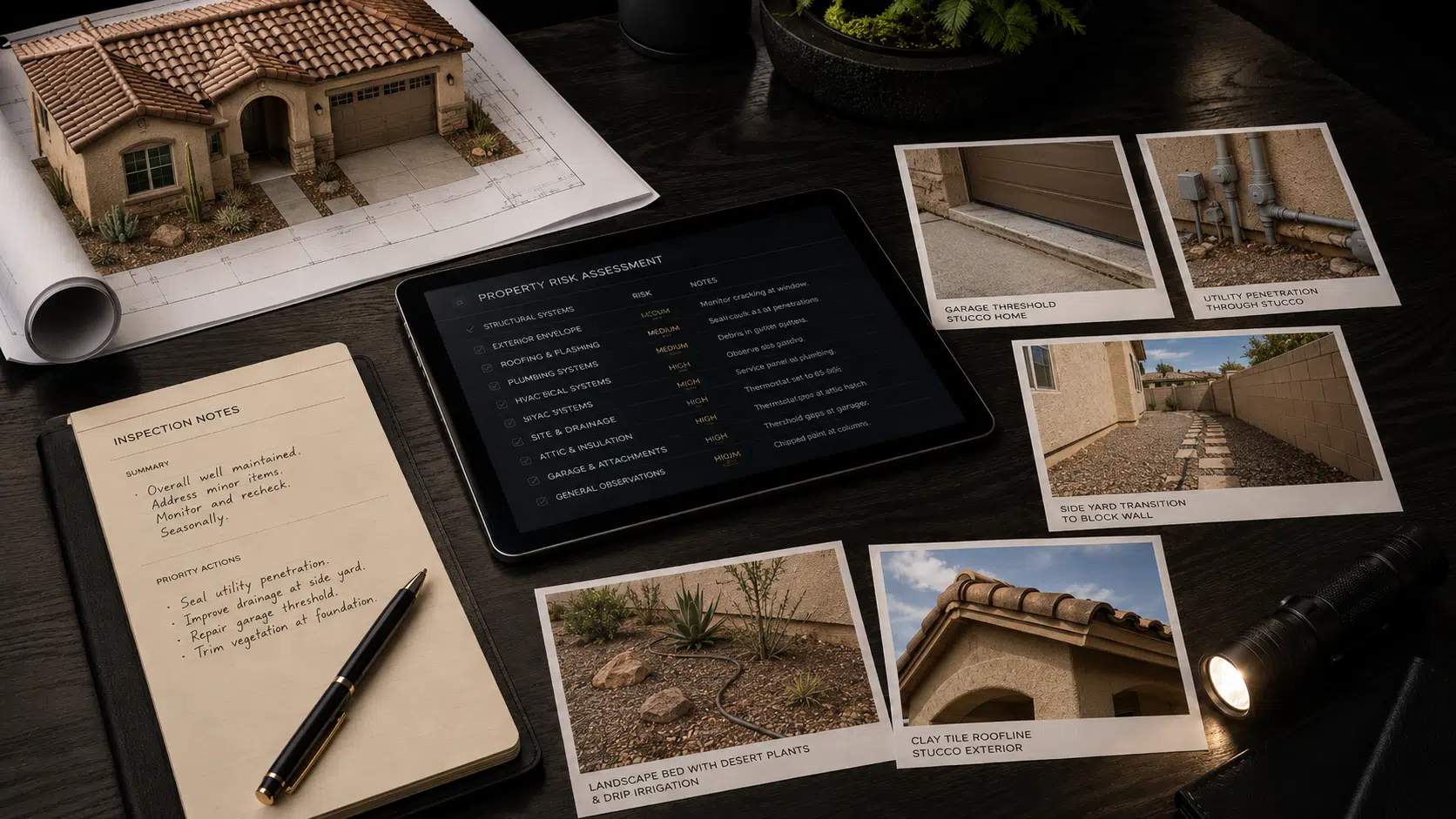
- The garage door?
- The personnel door?
- The attic penetrations?
- The utility penetrations?
- The expansion joints?
- The plumbing penetrations?
- The HVAC penetrations?
- The block wall penetrations?
- The roof transitions?
The recommendation sounds straightforward until someone attempts to execute it.
The same principle applies to landscape recommendations.
The same principle applies to pesticide recommendations.
The same principle applies to virtually every generic recommendation associated with scorpion control.
A Scorpion Sighting Is Most Often Evidence of a Larger Condition
Our intensive study and observations over many years shaped our understanding that a visible scorpion, dead or alive, is often a small symptom of a larger problem.
Scorpion sightings are symptoms. They are evidence.
The condition of the property, the house, and its location is the larger issue. Understanding this focuses on root cause, not generic symptom management.
A scorpion sighting often indicates:
- Existing neighborhood scorpion pressure.
- Favorable environmental conditions.
- Structural vulnerabilities.
- Landscape vulnerabilities.
- Microclimates that increase other pest populations.
- Barrier integrity deficiencies.
- Aggregation areas.
- A combination of many factors.
The visible scorpion is simply the part that was observed.
The objective should not be limited to reacting to the scorpion.
The objective should be to understand the conditions that allowed the scorpion to be present.
Pest Pressure Matters
One limitation of generic recommendations is that they assume all properties experience similar conditions. They do not.
Two homes on the same street may experience dramatically different levels of pest pressure.
- One property may back to a golf course.
- One may back to a wash.
- One may border open desert.
- One may contain landscape features that support prey populations.
- One may have neighboring conditions contributing to continual pressure.
- One may have significantly conducive microclimates.
- One may contain significantly more vulnerabilities than another.
The house matters. The environment matters. The pressure matters. The property’s lifestyle matters. Prescriptive treatment matters.
A recommendation that performs adequately on one property may perform poorly on another because the conditions are different.
The Barrier Integrity Principle
One of the concepts we discuss frequently at Seal Out Scorpions is the principle of a Pest Barrier Integrity System.
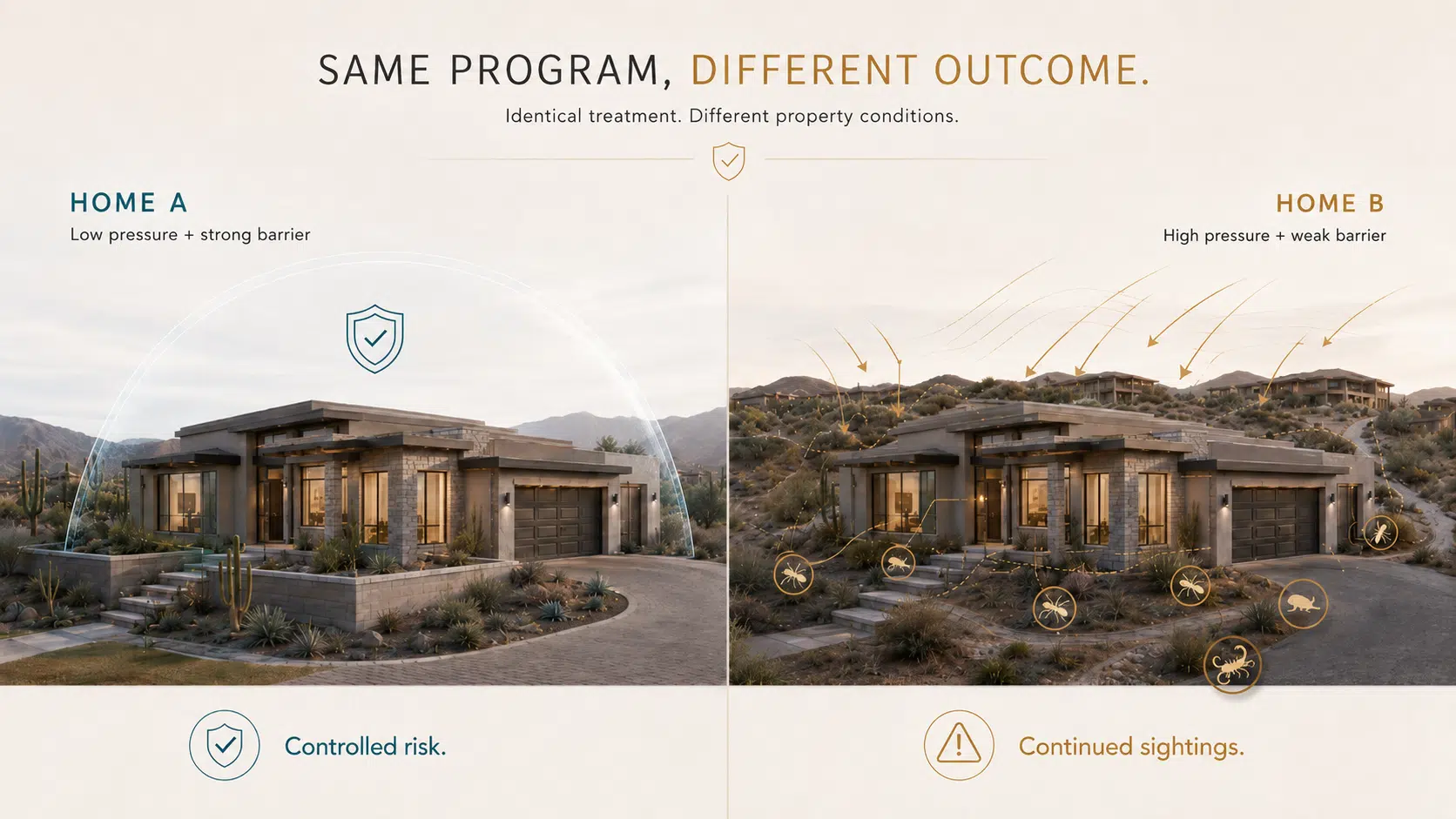
The concept is simply, the pest barrier integrity must be stronger than the scorpion or pest pressure.
If pest pressure increases, barrier strength must increase.
If vulnerabilities increase, barrier strength must increase.
If environmental support increases, barrier strength must increase.
This principle helps explain why identical pest control programs often produce different outcomes on different properties.
The pest control program may be identical.
The pest pressure is not.
The barrier integrity is not.
The vulnerabilities are not.
The property and how it is specifically used is not.
Building Performance and Scorpion Risk
Scorpions are frequently discussed as though they were a problem that could be primarily controlled with pesticides.
We do not believe that is accurate.
Scorpions are also a building performance issue.
Structures perform differently.
Some structures contain stronger barriers.
Some contain weaker barriers.
Most contain hundreds of opportunities for pest interaction.
Some contain fewer.
A structure with poor barrier integrity performs differently from a structure with strong barrier integrity.
A structure with significant vulnerabilities performs differently from a structure with limited vulnerabilities.
This does not eliminate the value of pest management.
It expands the strategy beyond pest management alone.
Pest Control, Pest Management, and Scorpion Risk Management
Historically, the industry focused on extermination.
The objective is to kill the pests.
The industry later evolved toward pest control.
Reduce pest populations and colonies.
The industry then adopted the term pest management.
The term implies a broader understanding of pest biology, behavior, treatment methods, and integrated strategies.
These are positive developments.
However, much of the industry still operates primarily within a control model in residential settings.
Products are selected.
Products are applied.
Populations are reduced.
At Seal Out Scorpions, our methods are both scorpion curative and risk management.
The distinction is important. Pest control focuses primarily on the pest. Sealing focuses primarily on obvious open gaps.
Scorpion Risk Management focuses on all the conditions supporting the pest.
Pest control asks:
How do we reduce scorpion activity?
Scorpion Risk Management asks:
Why is this property capable of supporting scorpion activity in the first place?
The answer may involve pest management.
It may involve exclusion.
It may involve landscape corrections.
It may involve building performance improvements.
It may involve education.
It always involves multiple factors and strategic methods working together.
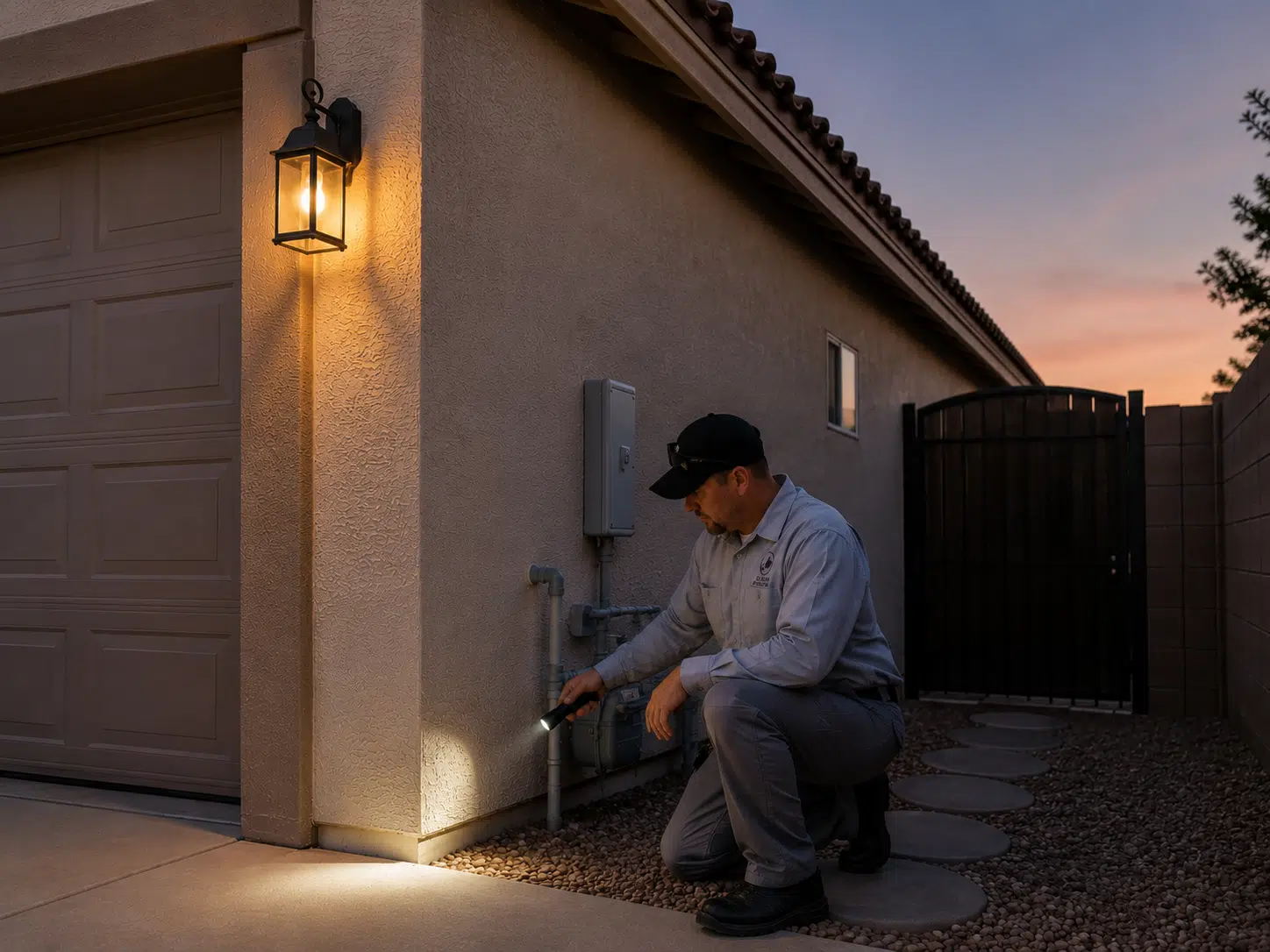
What We Do Differently
Our objective is not simply to reduce scorpion populations.
Our objective is to understand the conditions that allow scorpions to survive, aggregate, interact with the structure, and ultimately encounter the occupants. We understand scorpions as pests that do not damage a home. However, for many, it can create mental havoc. It can change how people live in their homes, raise their families, and lead their lives. Scorpions are more than a nuisance; they are a threat.
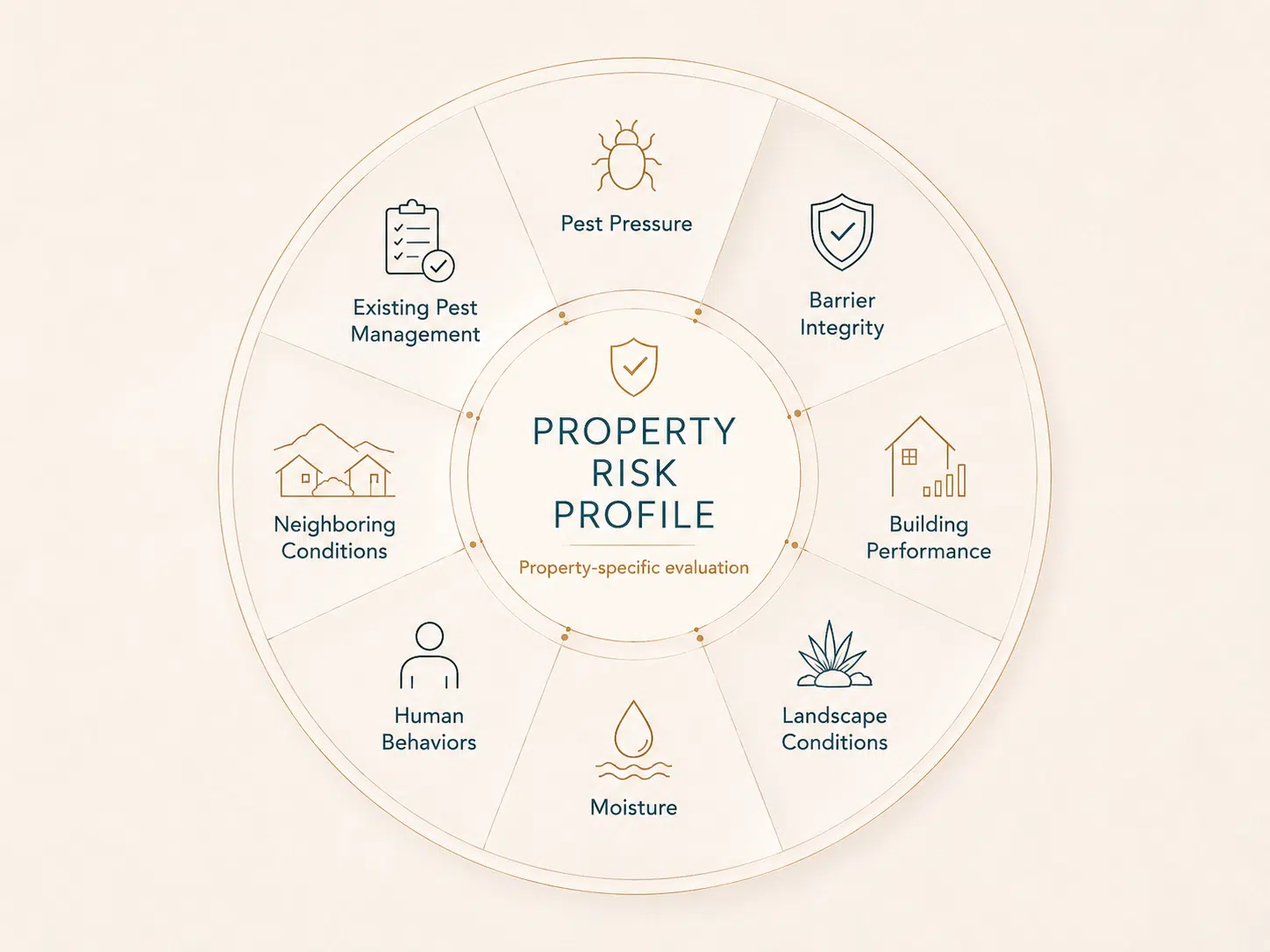
To reduce or eliminate the threat, it requires evaluation:
- Pest Pressure.
- Barrier Integrity.
- Building Performance.
- Property Vulnerabilities.
- Landscape Conditions.
- Existing Pest Management Programs.
- Human Behaviors.
- Environmental Influences.
- And more
No two properties are identical. No two risk profiles are identical. No two solutions should be identical.
Generic recommendations will always remain useful and can be a starting point to develop a plan.
However, generic recommendations are not a substitute for a prescriptive, property-specific strategy.
Final Thoughts
Generic recommendations are not always necessarily wrong. It may help. It may even work. Sometimes it will make conditions worse.
Generic information provides direction. The direction for a particular property or situation, is not always the best direction.
Prescriptive information provides an effective strategy.
Generic information explains what may be beneficial.
Prescriptive information helps determine order, timing, priority, dosage, and expected impact.
The distinction becomes increasingly important as complexity increases.
Arizona bark scorpions are a complex arachnid interacting with complex environments, complex structures, and complex conditions.
The most effective long-term results are rarely achieved through a single product, a single recommendation, or a single correction.
They are achieved by understanding the property, understanding the pressure, understanding the vulnerabilities, and systematically strengthening the barriers until they are stronger than the pest pressure.
That is the foundation of our approach to Scorpion Risk Management at Seal Out Scorpions.
About Georgia Clubb & Seal Out Scorpions®
Seal Out Scorpions is led by Georgia A. Clubb, Advanced Scorpion Specialist, together with William L. Clubb and Michael C. Golleher — Certified Building Analysts and Envelope Professionals through the Building Performance Institute, with additional Building Science Certificates and studies in Urban & Industrial IPM through Purdue University. Their team includes licensed pest management and sealing specialists who pioneered Building Performance Sealing to solve scorpion problems at the structural level.