









How to Find Scorpions at Night in Arizona and What a Scorpion Search Can Tell You
September can be an excellent month in Arizona to grab a blacklight and find out what is actually happening around your property.
Where they are found gives clues about pest pressure, pathways, available refuge, microclimates, prey, pesticide performance and the integrity of the property’s pest barriers.
That is why we encourage homeowners to conduct a night search, establish a baseline, and keep a log.
Why September 2026 Is Particularly Important
This has been an exceptionally high pest-pressure year in Arizona.
We have seen it with scorpions, crickets and other insects throughout the Valley.
There is rarely one simple explanation for a high pest year. Weather, food availability, reproduction, moisture, temperature, landscaping, irrigation, neighborhood pressure and pest-control practices can all play a part.
But the weather sequence leading into 2026 has been unusual.
Maricopa County came out of the wettest fall on record. That was followed by an unusually warm winter. By March, Phoenix temperatures were already spiking to around 100 degrees and above, essentially giving us what felt like an early summer.
Then we actually got a monsoon season.
Now El Niño is strengthening in the Pacific. We are watching that closely.
El Niño does not automatically mean Arizona will receive excessive rain; weather is not that predictable.
What concerns us is the possibility of another moisture-heavy fall or winter combined with warm temperatures.
If we go from a productive monsoon into another wet fall and then another warm winter, the environmental conditions supporting insects and scorpion prey may remain favorable much longer than normal.
That could make 2027 another difficult pest year.
We do not know that yet. What we can do now, though, is measure what is happening on individual properties.
That is why this September, with its current weather patterns, is an excellent time to establish a scorpion baseline.
Why Scorpions Glow Under a Blacklight
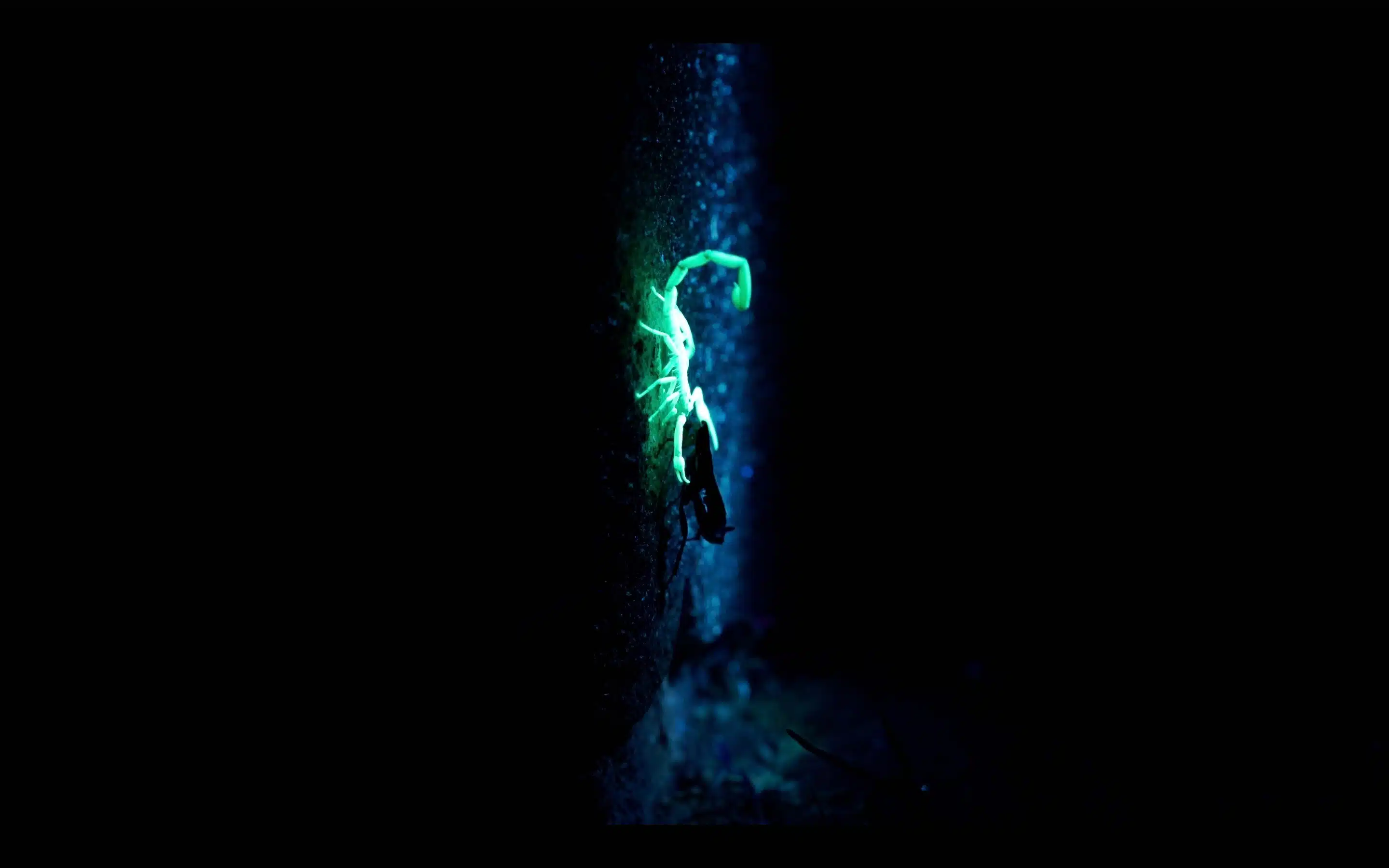
Scorpions fluoresce under ultraviolet light because compounds within their outer body covering react to UV wavelengths.
That bright blue-green glow makes them much easier to see after dark.
A bark scorpion can almost disappear against stucco, block, rock or tree bark under ordinary lighting.
Hit it with the right UV light and suddenly it becomes obvious.
This is one of the reasons nighttime searches are so useful.
We can see scorpions in places where we would never find them during a daytime inspection.
What Blacklight Should You Use?
For professional searches, we prefer a strong 365-nanometer UV light, such as the UV Beast 365 nm, rather than the purple 395 nm blacklights commonly sold online.
Both can make scorpions fluoresce. The difference is contrast.
A 395 nm light produces more visible purple light. That illuminates the wall, gravel, trees and everything else around the scorpion.
A good filtered 365 nm light produces less visible purple contamination and allows the scorpion’s fluorescence to stand out more sharply against the background.
If you are checking one wall in your backyard, a basic blacklight may work perfectly well.
When we are searching an entire residential property, sometimes thousands of square feet of walls, landscaping, structures and trees, beam strength and contrast make a significant difference.
It should be noted to wear UV eye protection. Also, never shine a high-powered UV light into someone’s eyes, and children should not use powerful UV flashlights unsupervised.
When Should You Search?
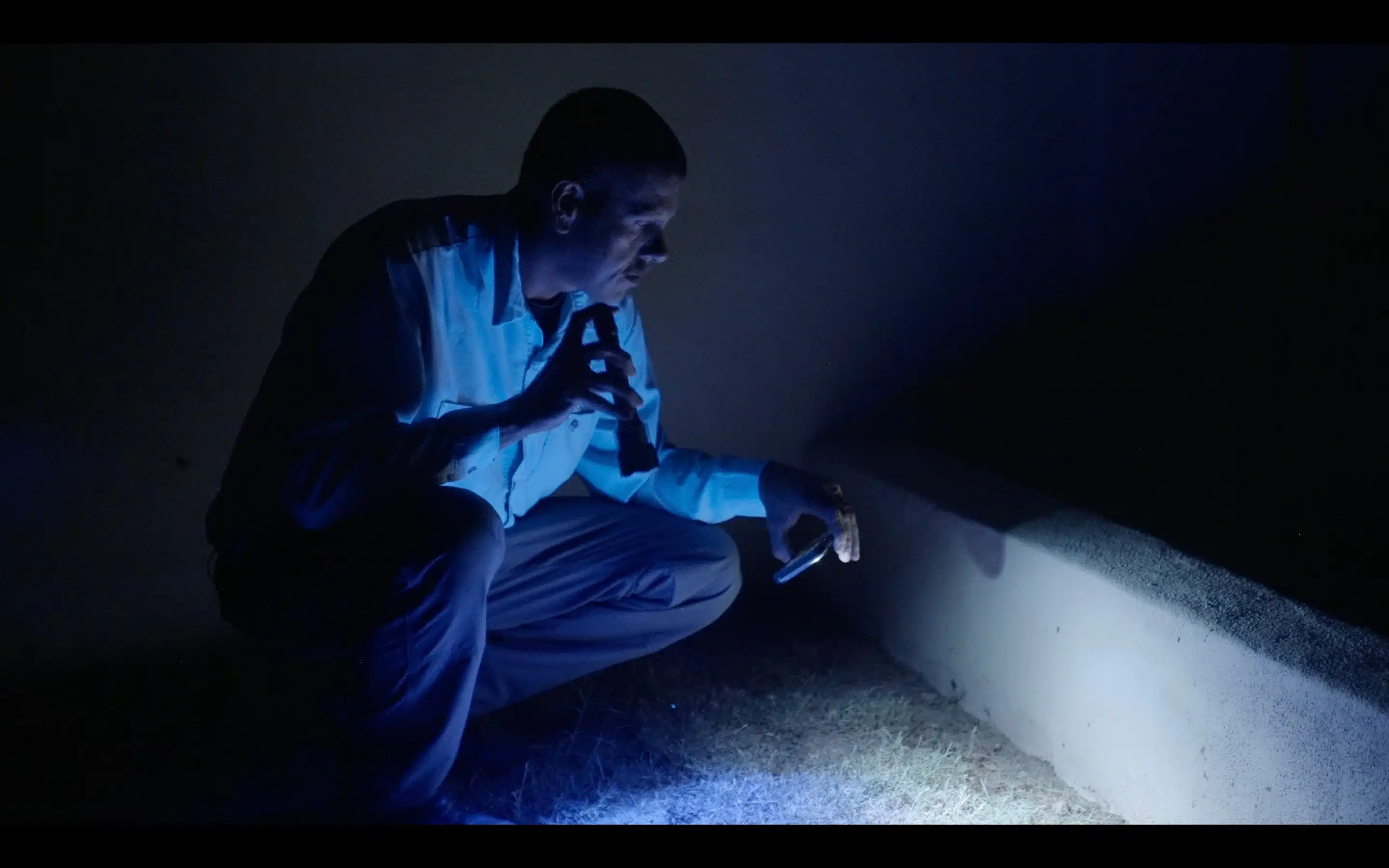
We generally conduct night searches in the early evening once it is dark.
That is when we commonly see Arizona bark scorpions emerging and becoming active.
Warm, humid and calm evenings tend to be productive search nights. But nothing with scorpions is absolute.
Activity can change with temperature, humidity, wind, recent rain, irrigation, yard work, pesticide applications, available prey and moon phase.
That is why two searches on the same property can produce very different numbers.
Finding 20 scorpions one night and eight another night does not necessarily mean the population dropped.
The conditions may have changed.
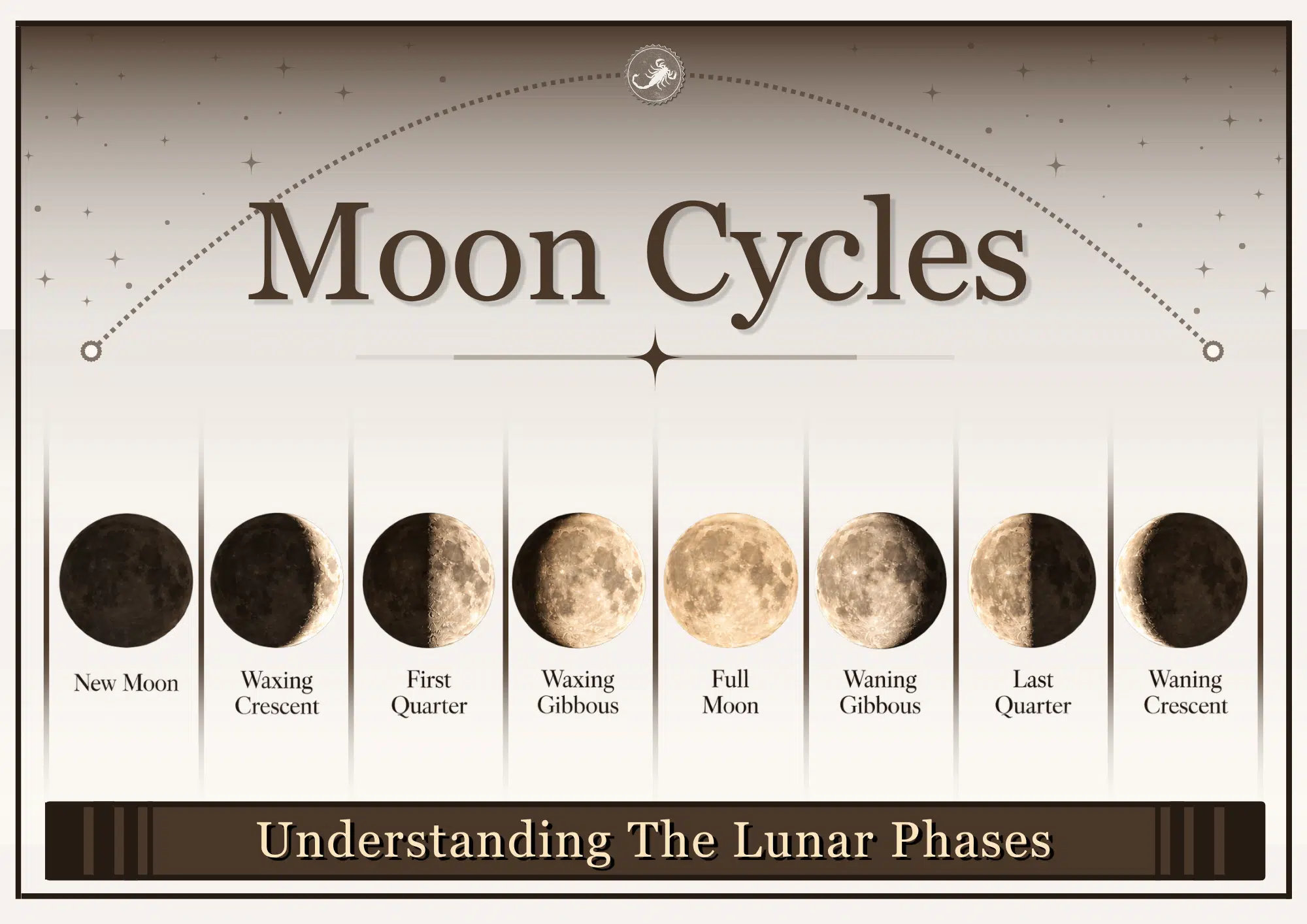
Moon Phase Matters, but It Is Not the Only Factor
Moon phase is interesting.
Research has shown changes in scorpion activity under different levels of nighttime illumination, and some studies have found lower activity during brighter moon conditions.
Gary Polis, one of the leading researchers in scorpion ecology, also documented differences in certain behaviors associated with moonlight.
There are theories about why.
Predation risk is one.
Navigation and environmental light cues have also been considered.
In our own field work, darker nights, particularly around the new moon, often produce better searches when other conditions are favorable.
That does not mean scorpions disappear during a full moon. They do not.
Moon phase is simply one variable we consider along with weather, temperature, humidity, wind and recent property activity.
How to Conduct a Scorpion Night Search
Do not randomly wander around the yard.
Start in one corner and systematically work your way around the property.
Search the perimeter first.
Then work toward the structure.
When possible, reverse your route and scan the same areas from the opposite direction.
We do this because a scorpion can be tucked behind a block edge, leaf, rock, expansion joint or landscape feature and be completely invisible from one direction.
Coming back from the opposite side changes the angle.
We commonly search block walls, foundations, exterior doors, garage areas, expansion joints, utility penetrations, planters, tree trunks, lower branches, retaining walls, landscape edging, irrigation boxes, pool equipment, outdoor kitchens, fireplaces, artificial turf transitions and dense vegetation.
And do not only look for an entire scorpion.
Sometimes all you see are two glowing pincers sticking out of a crack.
If You Find 10 Scorpions, You Do Not Have 10 Scorpions
This can be a misunderstanding homeowners have about night searches.
If you find 10 scorpions during a blacklight search, that does not mean there are 10 scorpions living around the property.
It means you found 10 scorpions that happened to be visible while you were searching.
Others may be inside cracks, block walls, landscape features, trees, under debris, beneath rock, in utility areas or simply inactive that evening.
Scorpions are energy minimizers. They do not all come out and wander around every night.
We have not found a study that establishes a reliable visible-to-hidden ratio for Arizona residential properties.
What we do know is that a blacklight search is a sampling of visible activity. It is not a census.
Where You Find the Scorpion Is Often More Important Than the Number
This is where a night search becomes useful diagnostically.
If most of the scorpions are on the perimeter wall, we may be looking at a travel corridor and an excellent pest-control control point.
If they are concentrated close to the house, that tells us something different.
If they are repeatedly found around exterior doors, our concern increases.
If they are concentrated in one landscape bed, tree line or particular feature of the yard, that area deserves attention.
If we are finding juveniles, that can indicate nearby reproductive activity.
If we are seeing scorpions combined with heavy cricket or insect activity, we start looking at the food web supporting the pressure.
This is why we teach our team not to simply report:
“Found 12 scorpions.”
Where?
Adult or juvenile?
At the perimeter or house?
On the ground or vertical surfaces?
Near doors?
In trees?
In landscape features?
Concentrated together or spread throughout the property?
Those details matter.
Cinder Block Walls Can Be an Important Control Point
Homeowners are often told that every block wall should be sealed because scorpions can hide inside them.
That sounds logical.
But scorpion management is rarely that simple.
We frequently find Arizona bark scorpions on exposed cinder-block walls at night.
From a pest-management perspective, that can actually be useful.
The wall becomes a predictable travel area and a control point.
Scorpions traveling across a visible, treatable surface can be easier to intercept than scorpions moving throughout trees, landscape features or directly against the structure.
After thousands of night searches, we have seen properties where changing wall refuge conditions also changes where scorpions are subsequently found.
That does not mean sealing a wall makes scorpions attack a house.
It means changing one part of the environment can change how pests use the property.
This is why we do not believe in sealing something simply because it has a crack.
We look at the property as a system.
The objective is to build a Pest Barrier Integrity System strong enough to overcome the pest pressure.
Sometimes an existing feature is not just a problem.
It may also be a control point.
You May See More Than Scorpions Walking Around

Scorpion activity documented during a nighttime blacklight assessment
Night searches can be fascinating.
We have seen scorpions feeding, mating, hunting insects, climbing trees, sitting on branches, fighting, cannibalizing other scorpions and females carrying babies on their backs.
Sometimes they are sitting completely exposed.
Other times they are positioned inside a crack with only their pincers showing, waiting for a moth, cricket or other prey to come close enough to strike.
For some homeowners this is fascinating.
For others it is terrifying.
For us, it is information.
We are trying to understand the stage and type of scorpion pressure developing around the property.
That helps us develop a prescriptive treatment plan instead of simply spraying because someone saw a scorpion.
Search Outside First for Root Cause Data
If your goal is figuring out why scorpions are getting inside the home, start outside.
An indoor scorpion is usually just the symptom.
The property around the house is where we begin looking for root causes.
Where is the pressure?
Where are the scorpions traveling?
Where are they finding refuge?
What prey is supporting them?
Are they remaining primarily at the perimeter or moving toward the structure?
Where are the important control points?
How strong are the house barriers compared with the pest pressure outside?
An indoor blacklight search can be useful, especially when we are investigating entry pathways.
But finding a scorpion inside tells us that the barrier has already been breached.
We want to understand why.
What Should You Do When You Find One?
If you are conducting a search to better understand your property, record where you found the scorpion before killing it.
Record whether it appears to be an adult or juvenile and whether it was on the ground, wall, tree, landscape feature or house.
You can also record the time, temperature, approximate humidity, wind and moon phase.
For individual scorpions, homeowners commonly use an insecticide, mechanically kill the scorpion, or use another direct method.
We use TERRO Scorpion Killer frequently during searches because it allows us to see it, spray it and kill the individual scorpion while continuing the inspection.
What we do not recommend is turning a night search into random pesticide spraying and flushing them to less desirable areas.
Observation first. Then determine the treatment strategy.
Pesticides are similar to pharmaceuticals and a prescriptive approach is essential for this non-insect, bark scorpion.
Keep a Scorpion Activity Log
One night gives you a snapshot.
Several searches start showing a pattern, especially over years.
At minimum, record the date, time, weather conditions, moon phase, number of live scorpions, number of dead scorpions and exact locations.
After a few searches, the pattern can become obvious.
You may find that most of the scorpions are concentrated along one wall.
You may find that the perimeter pressure is high but very few are reaching the home.
You may find repeated activity at one exterior door.
You may find that one portion of the landscaping consistently produces most of the findings.
That information is far more valuable than simply knowing that you found seven scorpions.
Why We Recommend a September Baseline
September is still warm enough in Arizona for strong scorpion activity, and it gives homeowners an opportunity to understand what developed during the summer before heading into fall and winter.
This year, that baseline is especially important.
We have had an unusual sequence of moisture and temperature events, a high-pressure pest season, an active monsoon and a strengthening El Niño in the Pacific.
Nobody can tell you today exactly what the 2027 scorpion season will look like.
But if we enter another wet fall followed by another warm winter, we will be watching the pest pressure very closely.
The best time to start understanding a property is before there is a crisis.
Pest management should work much like healthcare for a home.
First understand the symptoms.
Then diagnose the problem.
Understand the pressure, pathways and barriers.
Determine the appropriate treatment.
Then continue measuring.
A scorpion night search is one of the simplest ways a homeowner can begin doing that.
The number matters.
But the pattern matters more.
Want Help Understanding What You Find?
You can conduct your own scorpion night search.
Take notes on how many you find, where you find them, whether they appear to be adults or juveniles, and anything unusual you notice. A simple property map with the locations marked can be especially helpful.
If you are an existing Seal Out Scorpions client, call us with your findings. The number is useful, but the pattern and locations often tell us much more. We can help interpret what you are seeing and determine whether it indicates a change in pest pressure or whether your current treatment strategy should be evaluated.
For homeowners who want a more comprehensive evaluation, Seal Out Scorpions also conducts professional nighttime scorpion searches and Pest Barrier Integrity Diagnostics. We systematically search the property, document activity and look at the findings in relationship to the home, landscape, pest-control barriers, pathways and control points.
Whether you search or we search, the objective is the same:
Don’t just count the scorpions. Understand what they are telling you about the property.
About Georgia Clubb & Seal Out Scorpions®
Seal Out Scorpions is led by Georgia A. Clubb, Advanced Scorpion Specialist, together with William L. Clubb and Michael C. Golleher — Certified Building Analysts and Envelope Professionals through the Building Performance Institute, with additional Building Science Certificates and studies in Urban & Industrial IPM through Purdue University. Their team includes licensed pest management and sealing specialists who pioneered Building Performance Sealing to solve scorpion problems at the structural level.