








What Happens To Your Body When An Arizona Bark Scorpion Stings You?
Understanding the symptoms, neurological effects, risks to children and treatment of Arizona bark scorpion envenomation
An Arizona bark scorpion sting is more than a painful puncture.
The Arizona bark scorpion, Centruroides sculpturatus, produces a neurotoxic venom capable of interfering with the normal electrical signaling of the nervous system. Most stings in healthy adults remain localized and can be managed conservatively. Others progress beyond the sting site and produce neurological, muscular, cranial nerve, respiratory and autonomic symptoms.
Young children are particularly vulnerable to severe envenomation.
This is an area we study closely at Pest Science Group and Seal Out Scorpions because understanding scorpion control requires understanding the organism, its venom and what happens when the barrier between the scorpion and the resident fails.

What Is Actually Happening After a Bark Scorpion Sting?
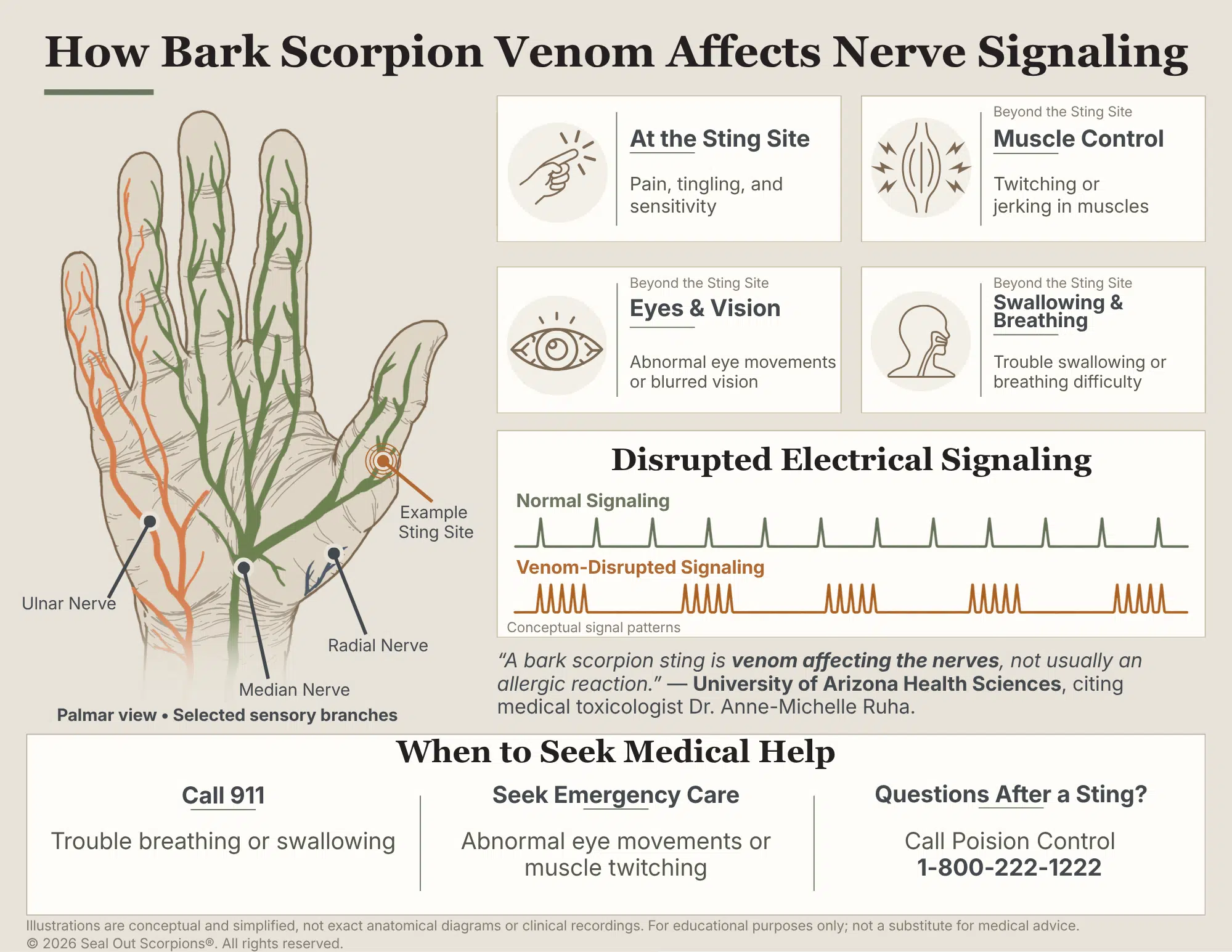
Bark scorpion venom contains neurotoxic peptides that affect ion channels involved in nerve-cell signaling. Classic Arizona research describes the effect as prolonged and excessive firing of neuronal axons. In practical terms, the nervous system begins receiving and transmitting abnormal signals.
That helps explain something important about bark scorpion envenomation: the symptoms can appear in seemingly unrelated parts of the body.
A person may be stung on a foot or hand but experience numbness or tingling traveling away from the sting site. More significant envenomation can affect eye movement, swallowing, saliva production, muscles, speech, breathing and other neurological functions.
The Arizona Poison and Drug Information Center describes immediate pain with little swelling as typical. Numbness, tingling and extreme sensitivity to touch, pressure, heat or cold can also occur.
The University of Arizona reports that symptoms generally develop within about 20 minutes and can continue worsening during the first four hours following envenomation.
What Does a Bark Scorpion Sting Feel Like In An Adult?
The classic symptom is immediate, often intense pain.
People describe burning, stinging, electrical or shock-like sensations. The area may become extremely sensitive. Something lightly touching the skin can produce disproportionate pain.
Other reported symptoms include:
- Burning or severe pain at the sting site
- Numbness and tingling
- Tingling or abnormal sensations extending away from the sting
- Extreme sensitivity to touch
- Muscle twitching or fasciculations
- Restlessness or agitation
- Difficulty coordinating movement
- Blurred or abnormal vision
- Difficulty swallowing
- Slurred speech
- Increased saliva or secretions
- Changes in smell or taste
- Abnormal or roving eye movements
- Rapid heart rate
- Elevated blood pressure
- Vomiting
- Respiratory distress in severe cases
The unusual taste some sting victims describe is particularly interesting.
It isn’t simply folklore.
A published Arizona case series involving three adults with severe Centruroides sculpturatus envenomation documented dysgeusia, or altered taste, along with other neurological effects including abnormal eye movements, impaired fine motor control and altered smell. All three ultimately required antivenom.
So when someone tells us, “I had a strange or metallic taste in my mouth after I was stung,” the altered taste itself is biologically plausible and documented in the medical literature.
We would be more careful with the word metallic, because the research establishes altered taste, not one universal taste sensation experienced by every patient.
What About The Throat And Respiratory Symptoms People Describe?
These deserve more attention because there are several possible sensations people may group together as “my throat felt strange.”
Scorpion envenomation can interfere with swallowing and neuromuscular control. It can also cause excessive salivation and secretions. More severe cases can progress to respiratory distress.
Difficulty swallowing, known medically as dysphagia, has been documented in Arizona bark scorpion envenomation. Earlier clinical research involving severe C. sculpturatus cases found restlessness, abnormal eye movement, paresthesias, excessive salivation, muscle fasciculations, blurred vision and dysphagia among the most frequently reported symptoms.
The University of Arizona specifically warns that difficulty swallowing and excessive secretions can become severe enough to interfere with the airway. In the most serious cases, patients may require intubation and mechanical ventilation.
That is different from simply saying scorpion venom “irritates the throat.”
A sensation of throat irritation or tightness following a sting should be taken seriously, but medically it is important to determine whether the person is experiencing abnormal sensation, difficulty swallowing, increased secretions, respiratory involvement or an allergic reaction.
Those are not necessarily the same biological process.
Children Can Look Very Different After a Bark Scorpion Sting
For parents, this is probably the most important part of the discussion.
A young child may not be able to say:
“My hand is tingling.”
“My tongue feels strange.”
“I can’t swallow normally.”
“My vision is moving.”
Instead, severe neurotoxicity can become visibly dramatic.
A child may become inconsolable or extremely agitated. The body can jerk or twitch. The eyes may begin moving uncontrollably. Saliva may pour from the mouth. Speech and swallowing can become difficult.
The “roving eyes” frequently associated with severe bark scorpion stings are a real neurological sign. The medical terms encountered in the literature include nystagmus and opsoclonus, depending upon the pattern of abnormal eye movement.
Arizona Poison and Drug Information Center data involving 593 healthcare-facility cases found nystagmus in 27.5%, hypersalivation in 15.3% and fasciculations in 14.8% of the reported cases.
The picture becomes even clearer when researchers look specifically at children with severe envenomation.
A study of 88 children with severe bark scorpion envenomation treated during a period when antivenom was unavailable reported:
100% neuromuscular agitation
97% opsoclonus
82% tachycardia
81% hypersalivation
49% hypertension
38% vomiting
33% respiratory distress
18% hypoxia
Twenty-four percent required intubation.
These percentages should not be interpreted as the risk following an average scorpion sting. This study specifically examined children who already had severe envenomation.
That distinction matters.
Most bark scorpion stings do not progress to this level.
Why Are Small Children At Greater Risk?
Dose matters.
A scorpion does not calculate a venom dose based upon the body weight of the person it stings. A biologically significant quantity of venom distributed through the body of a small child represents a very different exposure than the same quantity in a 180-pound adult.
The Arizona Poison and Drug Information Center identifies small children as the group at greatest risk for severe reactions.
This is why uncontrolled eye movement, muscle jerking, excessive drooling, difficulty swallowing, breathing difficulty or an inconsolable child after a suspected bark scorpion sting should never be dismissed as simply the child reacting badly to pain.
Those can be signs of significant neurotoxicity.
Does Being Stung Repeatedly Make Future Stings Worse?
Not automatically.
There is no good evidence establishing a simple rule that the fifth bark scorpion sting will be worse than the first or the twentieth worse than the fifth.
The venom from previous stings is not accumulating in the body year after year.
Each sting is a new envenomation.
The severity can vary with the amount of venom delivered, location of the sting, the individual and other circumstances.
There is, however, a second issue: immune sensitization.
Repeated exposure to animal venoms can cause susceptible individuals to develop an immune response to venom proteins. Scorpion venom-specific IgE has been demonstrated in humans with immediate hypersensitivity reactions to scorpion venom.
That means a later sting could potentially produce an allergic reaction that was not experienced with earlier stings.
That is fundamentally different from neurotoxic envenomation.
A person experiencing widespread hives, facial or tongue swelling, wheezing, faintness or rapidly developing throat or breathing problems may be experiencing an allergic emergency and requires immediate medical attention.
We therefore would not tell a client, “Every sting gets worse.”
The scientifically defensible statement is that repeated stings do not necessarily become progressively more toxic, but previous venom exposure can potentially alter the immune response in susceptible individuals.
How Are Bark Scorpion Stings Treated?
Treatment depends heavily upon the severity of the envenomation.
The Arizona Poison and Drug Information Center reports that the majority of stings in healthy young adults can be managed at home with guidance and follow-up. Recommended first aid includes washing the area with soap and water, applying a cool compress, positioning the affected limb comfortably and using appropriate over-the-counter medication for minor discomfort.
The University of Arizona reports that approximately 90% of sting exposures reported to its Poison Help Hotline can be managed at home.
If someone is stung, call the Arizona Poison and Drug Information Center at 1-800-222-1222, or 911 if symptoms are severe.
When neurological symptoms become clinically significant, treatment changes.
Historically, severe envenomation was managed with supportive care. That can include pain control, benzodiazepines for severe neuromuscular agitation, intravenous fluids, airway management and, when necessary, mechanical ventilation.
In the study of 88 severely envenomated children treated without antivenom, 98% received benzodiazepines, 69% received opioids and 84% received IV fluids. Almost one-quarter required intubation.
Today there is another important treatment available.
Anascorp: Antivenom For Scorpion Envenomation
Anascorp is the FDA-approved Centruroides scorpion antivenom used to treat clinically important signs of scorpion envenomation.
It is not simply a pain medication.
Anascorp contains equine-derived F(ab’)2 antibody fragments capable of binding and neutralizing circulating scorpion venom components. The FDA identifies it specifically for treatment of the clinical signs of scorpion envenomation.
According to the current prescribing information, signs warranting consideration of Anascorp include loss of muscle control, roving or abnormal eye movements, slurred speech, respiratory distress, excessive salivation, frothing at the mouth and vomiting.
The FDA-labeled initial dose is three vials intravenously. If clinically important symptoms remain, additional single-vial doses may be administered at 30- to 60-minute intervals while the patient is monitored.
The response can be striking.
In three documented adults with severe Arizona bark scorpion envenomation, severe symptoms resolved within approximately 30 to 60 minutes after a three-vial antivenom treatment.
A randomized controlled pediatric study also demonstrated rapid resolution of serious neurological symptoms with antivenom. Subsequent Arizona experience has shown the same fundamental advantage: neutralizing the venom can rapidly reverse clinically important envenomation and potentially reduce the need for prolonged intensive supportive care.
What Does Anascorp Cost?
This is where numbers need context.
There is no single universal “cost of an Anascorp treatment.”
There is the acquisition price of the drug, the hospital’s charge for the medication, the emergency department and professional charges, the amount negotiated by an insurer and ultimately the patient’s financial responsibility. Those numbers can be dramatically different.
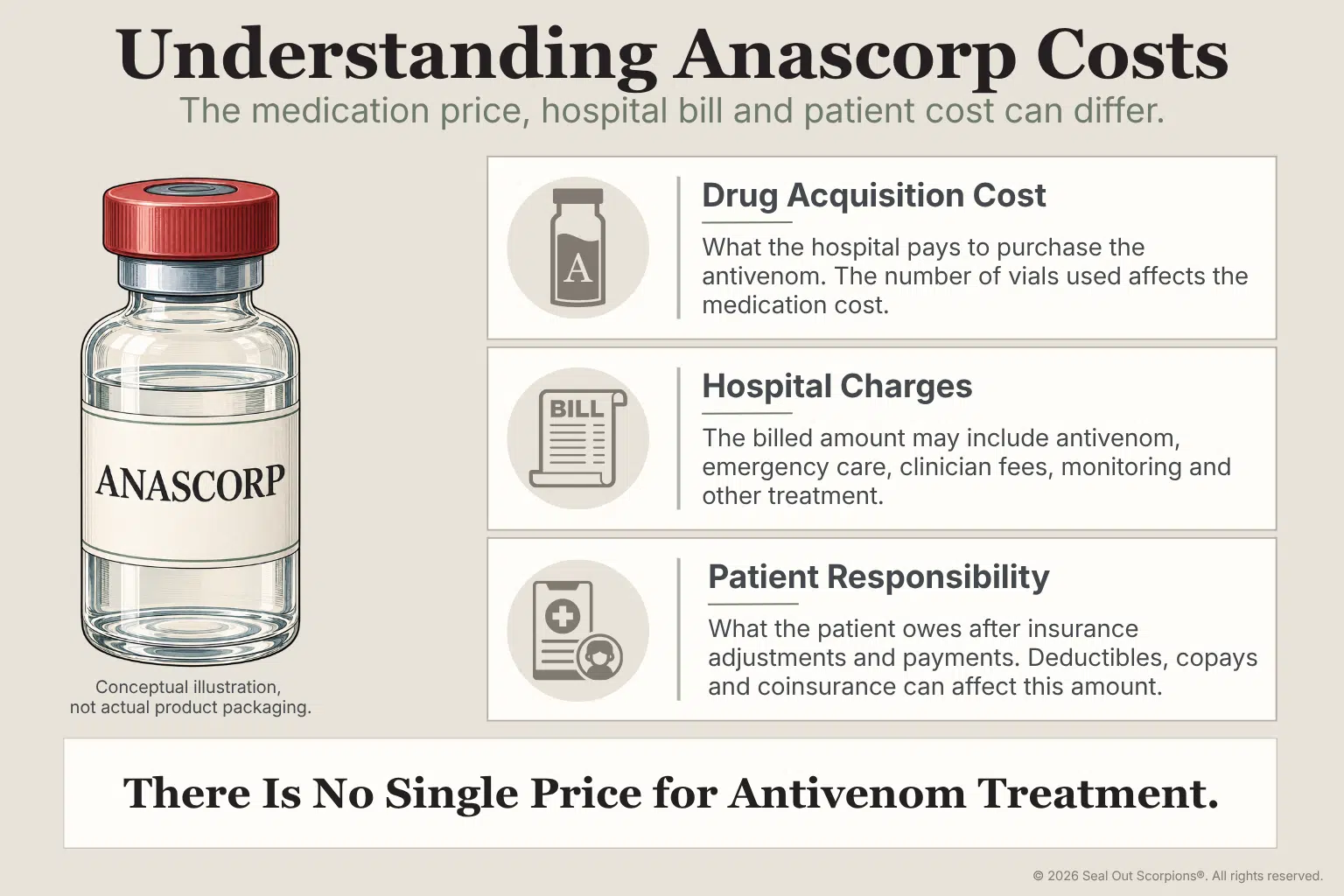
Published U.S. medical literature has cited Anascorp at approximately $3,750 per vial in acquisition cost, while other medical references note that hospital charges have historically reached $40,000 or more per vial.
Arizona provides a particularly well-known example.
A Chandler-area patient received two vials of Anascorp following a scorpion sting and initially received an approximately $83,000 hospital bill, with the Anascorp charges reported at nearly $40,000 per vial. The hospital subsequently reviewed and reduced its pricing.
Historical Arizona hospital charge data also demonstrate just how much pricing varied between facilities, with published charges ranging from roughly $7,700 to more than $21,000 per vial at different Phoenix-area hospitals during that period.
Those figures are historical examples, not a prediction of what a particular patient would be charged today.
The important economic point remains valid: a serious bark scorpion envenomation can become an expensive medical event, particularly when emergency treatment, antivenom, hospital admission, intensive care or respiratory support becomes necessary.
The medical decision to seek emergency care should never be delayed because of concern over the price of antivenom.
The Science Changes How We Think About Scorpion Control
For Pest Science Group, this is where toxicology connects back to applied pest management.
The Arizona bark scorpion is not simply an undesirable pest that happens to wander indoors. It is a medically significant venomous arthropod capable of producing neurotoxic envenomation.
Understanding that changes the objective.
The objective is not simply counting dead scorpions after a pesticide application.
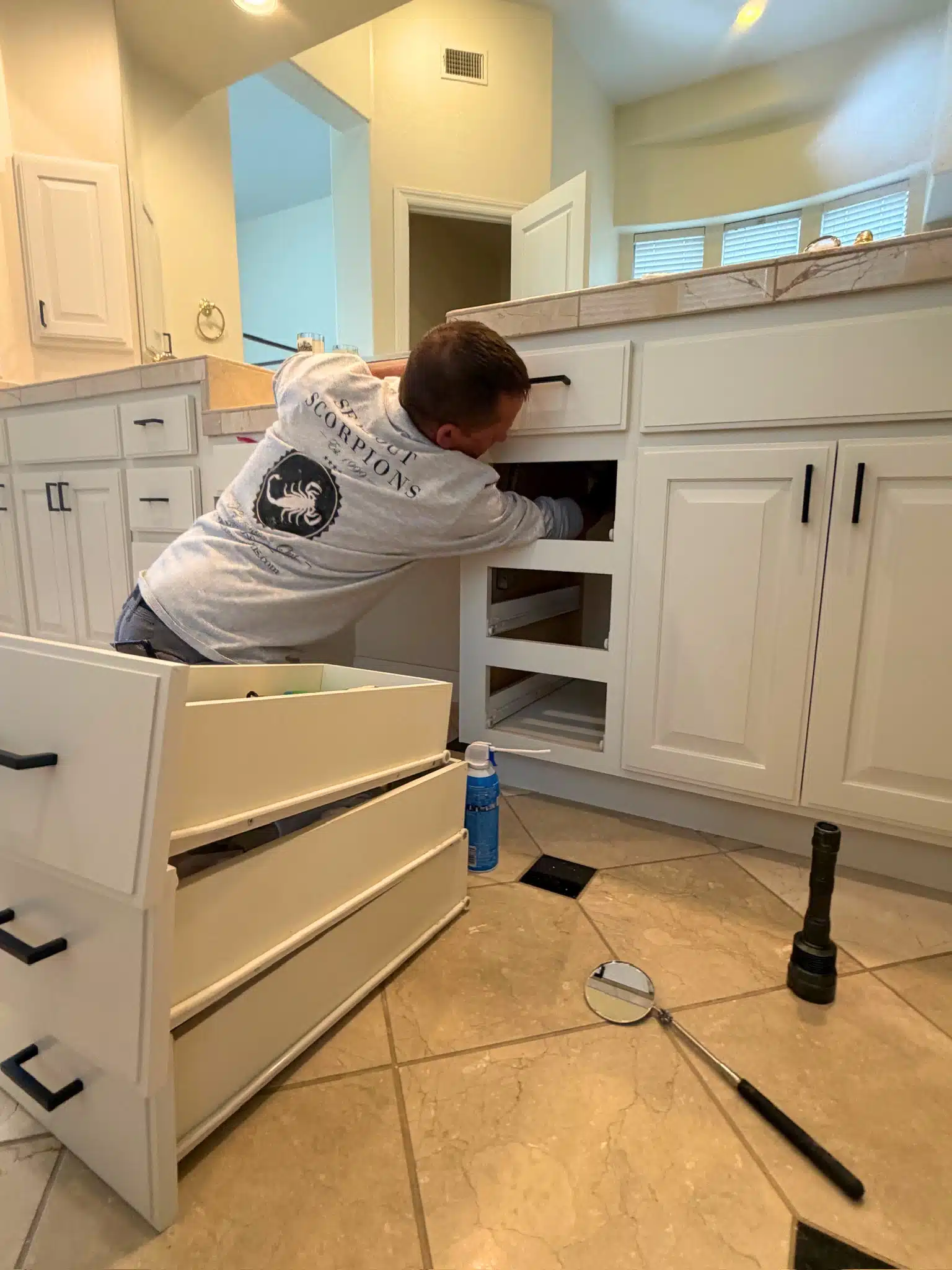
It is reducing the probability that the scorpion and the resident occupy the same space.
That requires understanding the surrounding scorpion pressure, landscape and harborage, prey availability, pest-control chemistry, treatment barriers, building pathways, airflow, doors and other mechanical openings, resident behavior and the physical integrity of the structure.
At Seal Out Scorpions and Pest Science Group, we study the work of toxicologists, physicians, entomologists, arachnologists, ecologists, building scientists and Integrated Pest Management researchers because scorpion management crosses disciplines.
We are an Applied Research company within a service provider.
Our job is to take established science and field evidence and determine how it applies to the residential environment.
When the consequence of barrier failure can be a venomous animal in a child’s bedroom, understanding the science matters.
References And Scientific Sources
Arizona Poison and Drug Information Center, University of Arizona College of Pharmacy. Scorpions: Signs, Symptoms and First Aid.
University of Arizona Cooperative Extension. Scorpions of the Desert Southwest United States.
Curry SC, Vance MV, Ryan PJ, Kunkel DB, Northey WT. Envenomation by the Scorpion Centruroides sculpturatus. Journal of Toxicology: Clinical Toxicology. Review of 670 central Arizona sting patients.
Berg RA, Tarantino MD. Envenomation by the Scorpion Centruroides exilicauda (C. sculpturatus): Severe and Unusual Manifestations. Pediatrics.
Boyer LV et al. Clinical Course of Bark Scorpion Envenomation Managed Without Antivenom. Study of severe pediatric envenomation and supportive treatment.
Clinical Toxicology. Centruroides sculpturatus envenomation in three adult patients requiring treatment with antivenom. Documents severe adult neurological manifestations including dysgeusia and response to antivenom.
U.S. Food and Drug Administration. Anascorp, Centruroides (Scorpion) Immune F(ab’)2 (Equine) Injection.
DailyMed, U.S. National Library of Medicine. Anascorp Prescribing Information. Current indications, dosing and clinically important signs of envenomation.
About Georgia Clubb & Seal Out Scorpions®
Seal Out Scorpions is led by Georgia A. Clubb, Advanced Scorpion Specialist, together with William L. Clubb and Michael C. Golleher — Certified Building Analysts and Envelope Professionals through the Building Performance Institute, with additional Building Science Certificates and studies in Urban & Industrial IPM through Purdue University. Their team includes licensed pest management and sealing specialists who pioneered Building Performance Sealing to solve scorpion problems at the structural level.