







What Effective Scorpion Sealing Actually Requires
A Home Is Not a Collection of Holes. It Is a System.
After more than 26 years specializing in scorpion problems, thousands of inspections, thousands of homes sealed or resealed, and thousands of nights spent studying where scorpions actually occur around structures, we have learned something very important:
Putting caulk in holes is not the same thing as sealing a home.
And sealing a home is not, by itself, scorpion control.
At Seal Out Scorpions, we believe the pest-control industry has treated structural exclusion too simply for too long.
Find a gap. Fill the gap.
See daylight. Caulk it.
Find another opening. Foam it.
That approach sounds logical. Sometimes it even appears to work for a while.
But a house isn’t a collection of independent cracks and holes.
A house is a living building system influenced by air, pressure, temperature, moisture, mechanical equipment, structural ventilation, materials, weather and the environment surrounding it.
That is why we were part of the development of Building Performance Sealing for scorpions and other pests.
And it is fundamentally different from what could be classified as Contractor Grade or Pest Control Grade sealing.
First, We Need to Define “Sealing”
One of the problems in pest management is that the word sealing can mean almost anything.
A pest-control technician may seal several visible penetrations.
A handyman may caulk cracks.
A contractor may seal construction joints or penetrations.
A homeowner may purchase foam and caulk and spend a weekend closing anything that looks like an opening.
All of those activities can be called “sealing.”
They are not necessarily the same thing.
Pest Control Grade Sealing
Pest Control Grade sealing is generally pest-focused and opening-focused.
The question is usually:
Where might the pest be getting in, and can we close that opening?
It may include caulking, foam, screening and spot repairs around visible or suspected pest-access locations.
Contractor Grade Sealing
Contractor Grade sealing is generally repair- or construction-focused without regard to timing from a building science or a pest perspective.
The question is usually:
What joint, crack or penetration needs to be closed?
A contractor may be very skilled at the work he or she performs. But repairing individual construction openings is different from evaluating the house as an interconnected pest barrier and building system.
Building Performance Sealing
Building Performance Sealing starts with a different question:
How is this building actually functioning—and how do we improve its physical pest barrier without ignoring the systems that make the house work to include its mechanical and structural ventilation along with its HVAC system?
That changes everything.
Caulk Is a Material. It Is Not a Sealing Strategy.
One of the greatest misconceptions about pest exclusion is that caulk is the answer to most openings.
It isn’t.
Different locations can require different materials, designs and methods. Some openings should be sealed. Some require screening. Some require flexible materials capable of accommodating movement. Some involve drainage or ventilation that must remain functional. Some require a combination of materials.
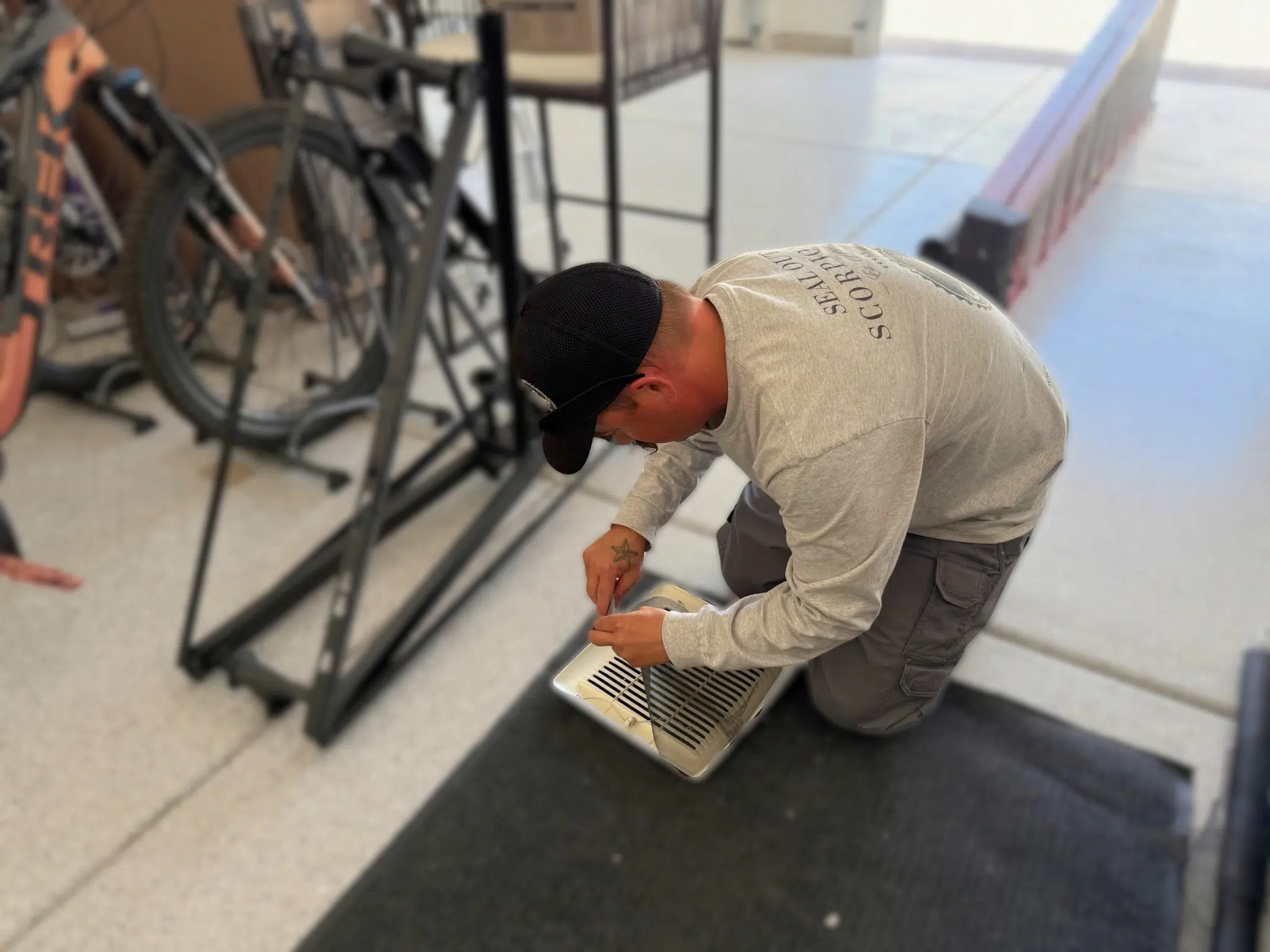
And some conditions should be corrected rather than simply covered.
The science of building sealants itself demonstrates why this matters.
ASTM C1193, the Standard Guide for Use of Joint Sealants, identifies considerations including material properties, backing, primers, substrate preparation, installation, joint design and environmental conditions. ASTM also recognizes that compatibility with adjacent materials, workmanship, joint design, maintenance and environmental exposure can affect the service life of a sealant joint.
ASTM’s guidance on sealant-joint movement goes even further: building movement, tolerances and environmental conditions must be considered if a joint is expected to remain effective against air and water intrusion.
In other words:
Even the sealant industry doesn’t treat sealant as “just put some caulk in the crack.” Neither should pest exclusion.
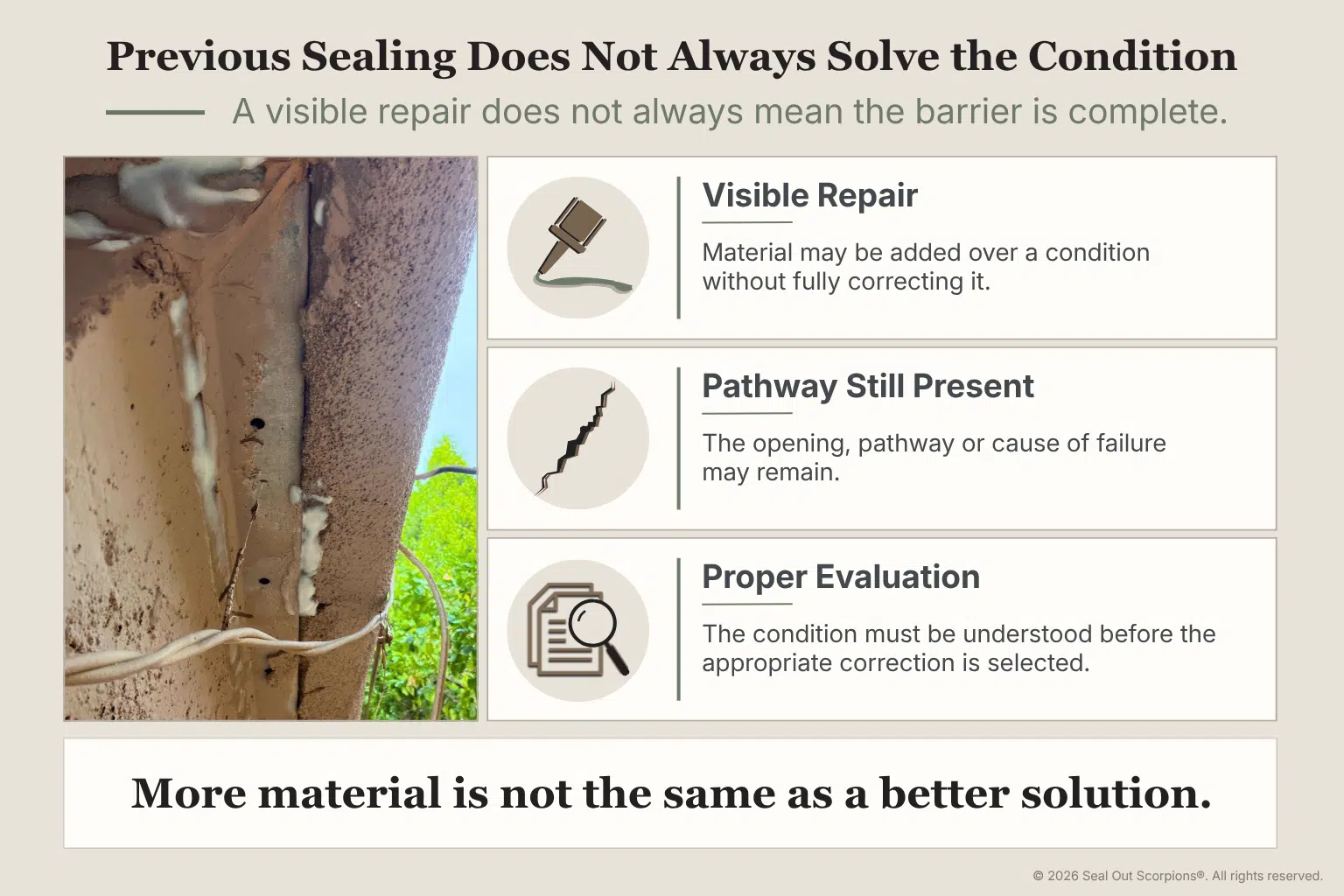
We Call It “Sealant Scar Tissue”
We inspect homes that have been sealed before all the time.
Sometimes more than once.
A little caulk was added here.
Foam was added there.
Someone came back and put another bead over the first bead.
Another company sealed it again.
Years later, instead of having a thoughtfully designed barrier, the house has accumulated layers of repairs.
We call this sealant scar tissue.
It can be messy, visually obvious and difficult to diagnose. More importantly, adding another layer of material does not automatically correct the condition underneath it.
More sealant does not necessarily mean a better-sealed home.
Sometimes the better solution is not to add more.
Sometimes it is to understand why the previous repair failed.
Building Science Changes the Conversation
The U.S. Department of Energy makes an important statement in its consumer guidance:
“Air sealing and ventilation go hand in hand.”
That single sentence captures a major difference between Building Performance Sealing and simple pest exclusion.
DOE Building America guidance also recognizes that pressure differences between spaces can induce unwanted airflow through a building envelope.
EPA takes a similarly interconnected approach to high-performance homes, addressing moisture, HVAC, ventilation, air sealing and pest pathways as parts of overall building performance.
Why does that matter for scorpion exclusion?
Because air moves through buildings.
An HVAC system moves air.
Exhaust fans move air.
Wind creates pressure.
Temperature differences create pressure.
Duct leakage can create pressure differences.
And when pressure exists, air seeks pathways through available leakage points in the building envelope.
A home can contain hundreds of small leakage pathways—what we call micro-air leaks.
These pathways may communicate with attics, wall assemblies, penetrations and other concealed spaces.
Seal one pathway and you have changed the building.
You haven’t necessarily eliminated the pressure that was moving air through it.
That pressure may now act upon another available pathway.
That is one reason we are cautious about partial sealing.
The Balloon Principle
One of the simplest ways we explain this to homeowners is to imagine a house as a balloon—but one with an HVAC system, exhaust systems and hundreds of tiny openings.
Change an opening and you change how air moves.
This doesn’t mean that sealing an opening is wrong.
It means you should understand the building before assuming that closing several visible holes constitutes a complete solution.
This is especially important when we hear:
“We had the house sealed. It seemed better for a while, but then the scorpions started showing up again.”
We hear versions of that story repeatedly.
Our field experience suggests that incomplete exclusion can sometimes change where activity appears rather than resolving all of the structural opportunities that allowed the problem to occur.
That observation is one of the reasons Seal Out Scorpions and Pest Science Group continue studying the relationship among structural pathways, micro-air leakage, moisture, scorpion behavior and building pressure.
Scorpions Are Not Insects—and Their Behavior Matters
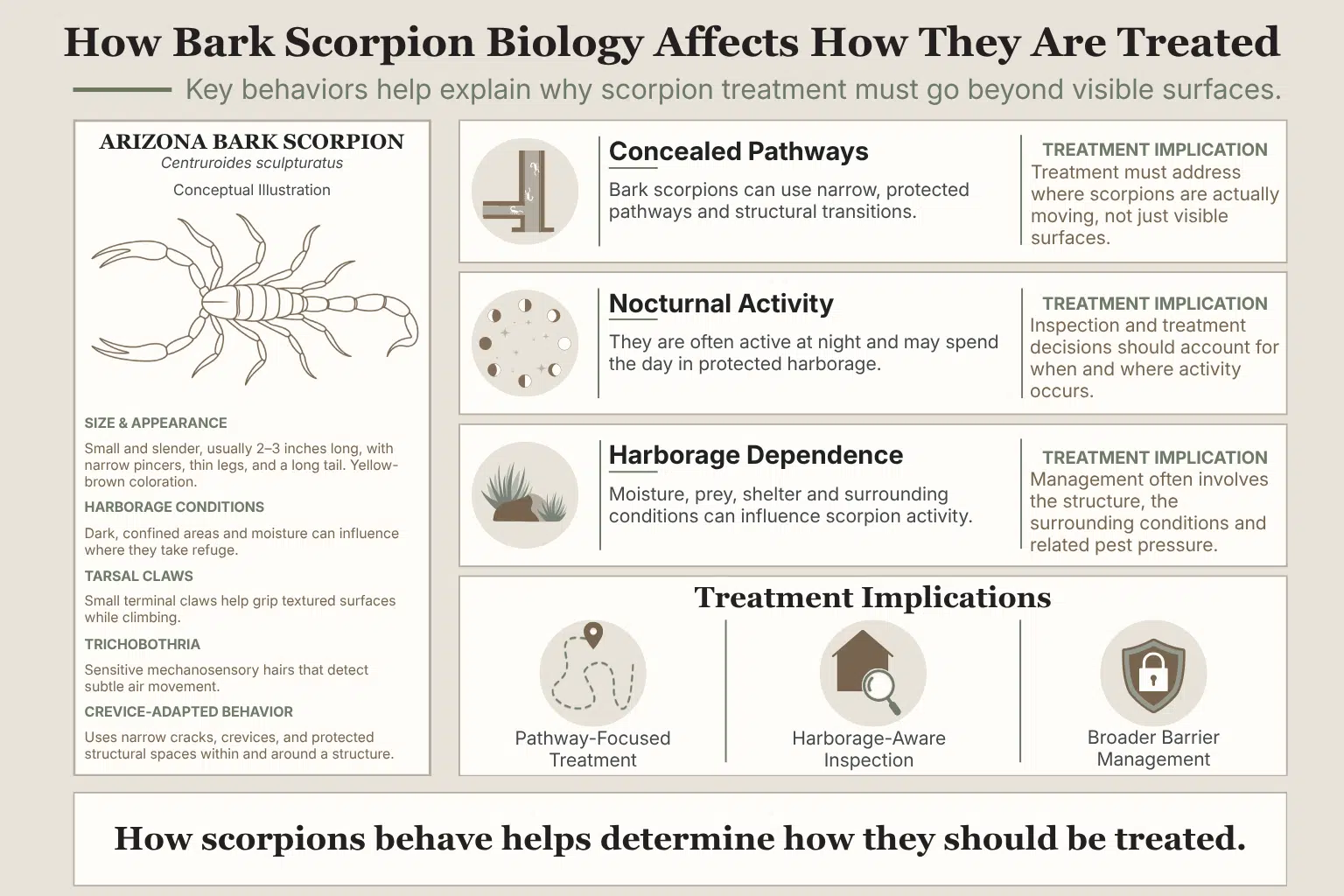
Scorpions are arachnids, not insects.
Arizona bark scorpions are particularly adapted to using structural environments.
University of Arizona research has documented significant preference by Arizona bark scorpions for structural harborage and narrow crevices.
University of Arizona Cooperative Extension also reports that bark scorpions readily enter narrow cracks and crevices in hollow-block walls and seek dark, confined locations; moisture can also influence where they seek refuge.
There is another fascinating piece of scorpion biology relevant to our research.
Scorpions possess extraordinarily sensitive mechanosensory hairs called trichobothria. Research has established that these structures allow scorpions to perceive subtle air movement. Modern research continues to study this remarkable airflow-sensing ability.
Does that prove an Arizona bark scorpion standing inside a wall follows HVAC leakage directly into your bedroom?
No—and we won’t pretend science has established something it hasn’t.
But it gives us a scientifically credible question to investigate.
After decades of field observations, Seal Out Scorpions and Pest Science Group are studying whether structural airflow, pressure differences and micro-air leakage may contribute to the pathways scorpions use within buildings.
That is applied research.
We start with what science already knows, compare it with what we repeatedly observe in actual homes, document it, test it and continue asking better questions.
Sealing Alone Is Not Scorpion Control
This may be the most important distinction of all.
We do not believe even excellent structural sealing, by itself, constitutes complete scorpion management.
A sealed house still exists inside a yard.
The yard exists inside a neighborhood.
Scorpions move through that environment.
Their prey exists in that environment.
Moisture exists there.
Landscape, irrigation, block walls, neighboring properties, drainage, construction and pest-management practices can all influence the pressure surrounding an individual home.
That is why our larger model is the Pest Barrier Integrity System.
The Four Barriers of Pest Barrier Integrity
-
The Home — Physical Barrier Integrity
The structure must be evaluated and appropriately sealed using building-performance principles.
This is Building Performance Sealing.
-
The Yard — Pest Management Barrier
Scorpion pressure and prey populations outside the structure must be actively managed.
The objective isn’t simply to spray the house.
It is to understand and manage the biological pressure surrounding it.
-
The Property — Landscape Management
Vegetation, irrigation, moisture, storage, block walls, harborage, debris, lighting and other environmental conditions can influence pest and scorpion activity.
Landscape decisions become part of pest management.
-
The Homeowner — Knowledge and Stewardship
The homeowner is part of the system.
Understanding the property, recognizing changing conditions, knowing what neighboring properties may contribute, maintaining the structure and landscape, and reporting activity gives the property another layer of protection.
House. Yard. Landscape. Homeowner.
When those four barriers work together, we call it Pest Barrier Integrity.
Why General Pest Control Alone Often Isn’t Enough
Traditional pest control was largely built around controlling insects and other pests with pesticides.
Scorpions present a different challenge.
A pesticide application can be one component of management. But if a property continues producing prey, harborage and structural opportunity, spraying alone does not address the entire system.
Likewise, sealing the structure while ignoring the exterior population doesn’t address the entire system.
And landscaping changes without structural protection don’t address the entire system.
Scorpion management becomes much more logical when we stop looking for one product or one service to solve a multi-system problem.
That is the fundamental philosophy behind Pest Barrier Integrity.
Building Performance Sealing Can Reveal More Than Pest Openings
There is another benefit to looking at the building rather than merely hunting for cracks.
You start noticing the building.
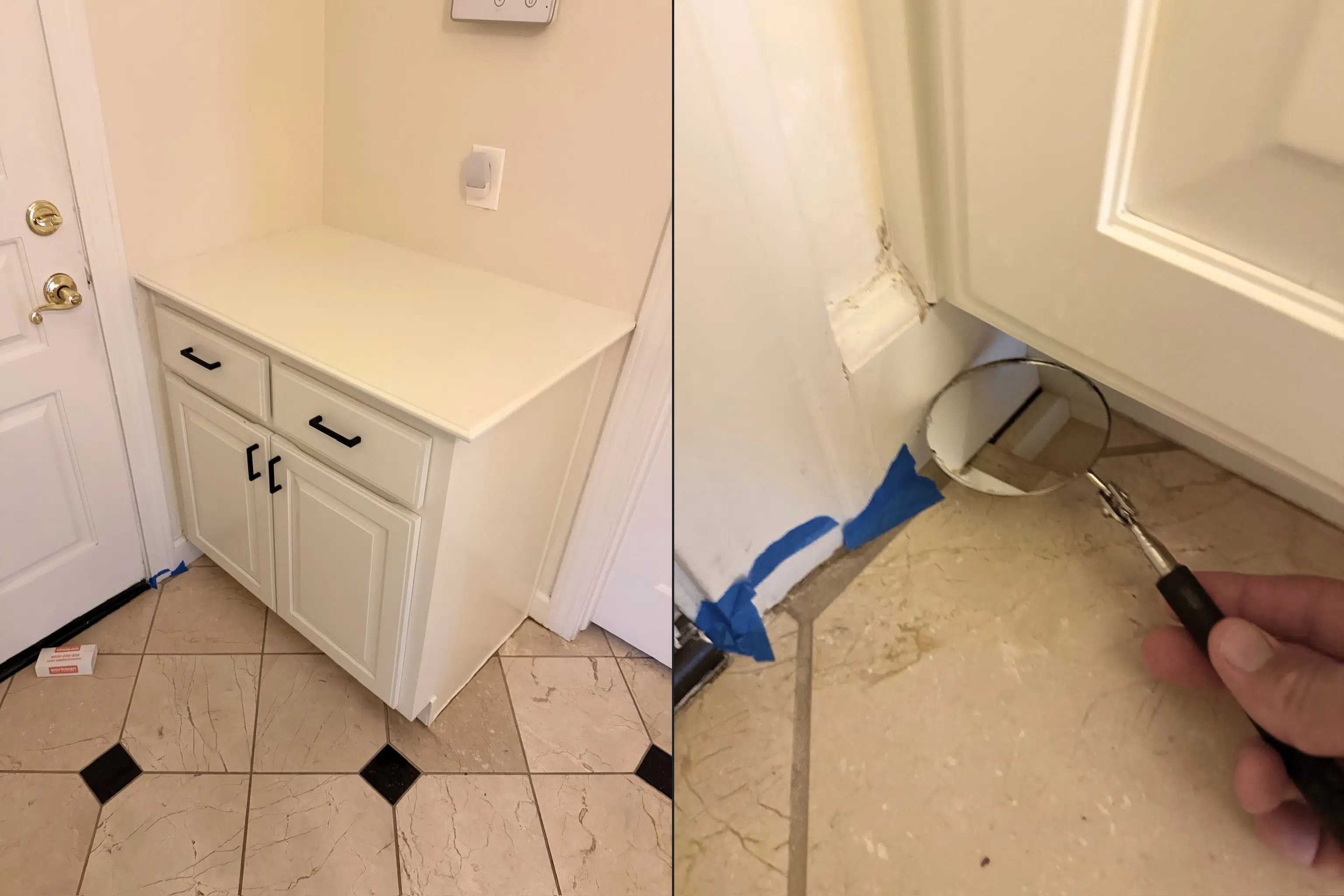
During Building Performance Sealing evaluations and projects, conditions may become visible that a homeowner never knew existed: evidence of moisture, deteriorated materials, failed previous sealants, construction defects, unusual penetrations, air leakage pathways or other conditions that may warrant further evaluation by the appropriate building professional.
Building Performance Sealing is not a substitute for HVAC, engineering, roofing, plumbing or other licensed specialties.
It is simply a much more observant way to approach pest exclusion.
And air sealing can have benefits beyond pest management.
DOE identifies air sealing as an important component of home energy performance and notes that reducing drafts and air leakage can improve comfort and efficiency.
That is why we describe what we do as micro-weatherization with a pest-management purpose.
Why Isn’t All Pest Sealing Done This Way?
Because pest exclusion has developed differently from building science.
There are extensive standards governing particular construction materials and practices. There are standards addressing sealants. There are building and energy codes. There are pest-management licensing requirements.
But those are not the same thing as having a universally recognized professional discipline specifically governing whole-home pest exclusion through building-performance principles.
That distinction matters.
Who determines what should be sealed?
Who determines what should remain ventilated?
Who determines which material belongs in which location?
Who considers movement?
Who considers weather exposure?
Who considers drainage?
Who considers HVAC pressure?
Who considers moisture?
Who considers pest biology?
Who considers what previous sealing has already changed?
And who looks at all of those questions together?
That is the gap we believe needs to be filled.
We Are Working Toward a Standard
Seal Out Scorpions began in 1999.
Over the years, we have sealed and resealed thousands of homes and performed thousands of inspections.
Some of our most valuable education has come from homes that had already been sealed.
We have been able to see what lasted.
What failed.
What was missed.
What became messy.
What created sealant scar tissue.
What homeowners were told.
Where scorpions were still appearing.
And how the structure, yard and surrounding environment interacted.
Today, we are combining that field history with building-science education, Building Performance Institute-trained personnel, structured field diagnostics and the applied research work of Pest Science Group.
Our objective is bigger than developing another sealing service.
We are working toward a defined discipline for pest-focused Building Performance Sealing.
That means terminology.
Training.
Installation principles.
Material-selection principles.
Diagnostics.
Documentation.
Quality assurance.
Building-science considerations.
Pest biology.
And eventually, measurable standards by which the work can be evaluated.
We don’t believe “we sealed the house” should be the end of the conversation.
It should be possible to explain what was sealed, why it was sealed, how it was sealed, what material was selected, what building function was considered and how that work fits into the property’s overall pest-management system.
The Difference Is Not the Caulk
A homeowner comparing sealing estimates may see dramatically different prices and assume everyone is quoting essentially the same service.
They may not be.
One company may be selling labor and sealant.
Another may be selling pest exclusion.
Building Performance Sealing is intended to address the home as a building system and the physical component of a larger Pest Barrier Integrity strategy.
That is a different scope.
A different methodology.
And ultimately, a different investment.
For homeowners dealing with Arizona bark scorpions, the question shouldn’t simply be:
“How much does it cost to seal my house?”
A better question is:
“What system is being used to protect my home?”
Because after more than two decades working with scorpion homes, our conclusion is simple:
Scorpions don’t experience your property as separate pest-control, construction, landscaping and HVAC problems. Neither should your scorpion-management strategy.
Building Performance Sealing protects the structure. Pest Barrier Integrity protects the system.
That is the difference.
About Georgia Clubb & Seal Out Scorpions®
Seal Out Scorpions is led by Georgia A. Clubb, Advanced Scorpion Specialist, together with William L. Clubb and Michael C. Golleher — Certified Building Analysts and Envelope Professionals through the Building Performance Institute, with additional Building Science Certificates and studies in Urban & Industrial IPM through Purdue University. Their team includes licensed pest management and sealing specialists who pioneered Building Performance Sealing to solve scorpion problems at the structural level.