









Why Are Scorpions, Crickets, Roaches and Other Pests So Bad in Phoenix This Year?
The 2025–2026 weather pattern created unusually high pest pressure, and the effects may continue
If it feels like scorpions, crickets, cockroaches and other pests are worse across the Phoenix metropolitan area this year, you are probably not imagining it.
We are hearing it from homeowners. We are seeing it on properties. Our technicians are encountering heavier pest pressure, earlier activity and conditions that do not look like an ordinary year.
I have worked with scorpions in Arizona since founding Seal Out Scorpions in 1999. Over more than 26 years and approximately 9,000 clients, I have learned that scorpion problems do not happen in isolation.
Scorpion pressure is connected to the weather, the available food supply, the surrounding environment, irrigation, landscaping, construction, the condition of the building envelope and the quality of the pest management program.
Every year is different, but the sequence leading into the summer of 2026 has been especially unusual:
- Phoenix experienced its wettest fall on record.
- That was followed by a very warm and mostly dry winter.
- March brought historically early and extreme heat.
- Scorpion stings were already being reported at elevated levels well before the traditional peak season.
These conditions compounded. They did not cancel one another out.
The rain supported biological activity. The warm winter reduced the normal seasonal slowdown. The historic March heat moved the activity season forward.
Now, in mid-July, homeowners are experiencing the results.
Seal Out Scorpions as an Arizona Regional Specialist
Seal Out Scorpions is an Arizona Regional Specialist focused on residential bark scorpion risk management, Building Performance Sealing®
and applied field science.
What does that mean?
It means we do more than look at a scorpion and decide what pesticide to apply.
We study how bark scorpions and their prey interact with:
- Sonoran Desert weather patterns
- Irrigated residential landscapes
- Neighborhood pest pressure
- Block-wall systems
- Construction methods
- Building openings
- Airflow and pressure
- Moisture gradients
- Door and garage systems
- Pest-control products
- Treatment timing
- The condition and performance of the building envelope
Our work combines pest biology, building science, treatment chemistry, regional weather data and observations collected through residential field work.
This article is not based only on our opinion that pests seem worse. There is outside evidence documenting the extraordinary weather conditions and unusually early scorpion encounters. Those records align with what our teams are seeing across Phoenix-area properties.
It Started With the Wettest Fall in Phoenix History
Meteorological fall includes September, October and November.
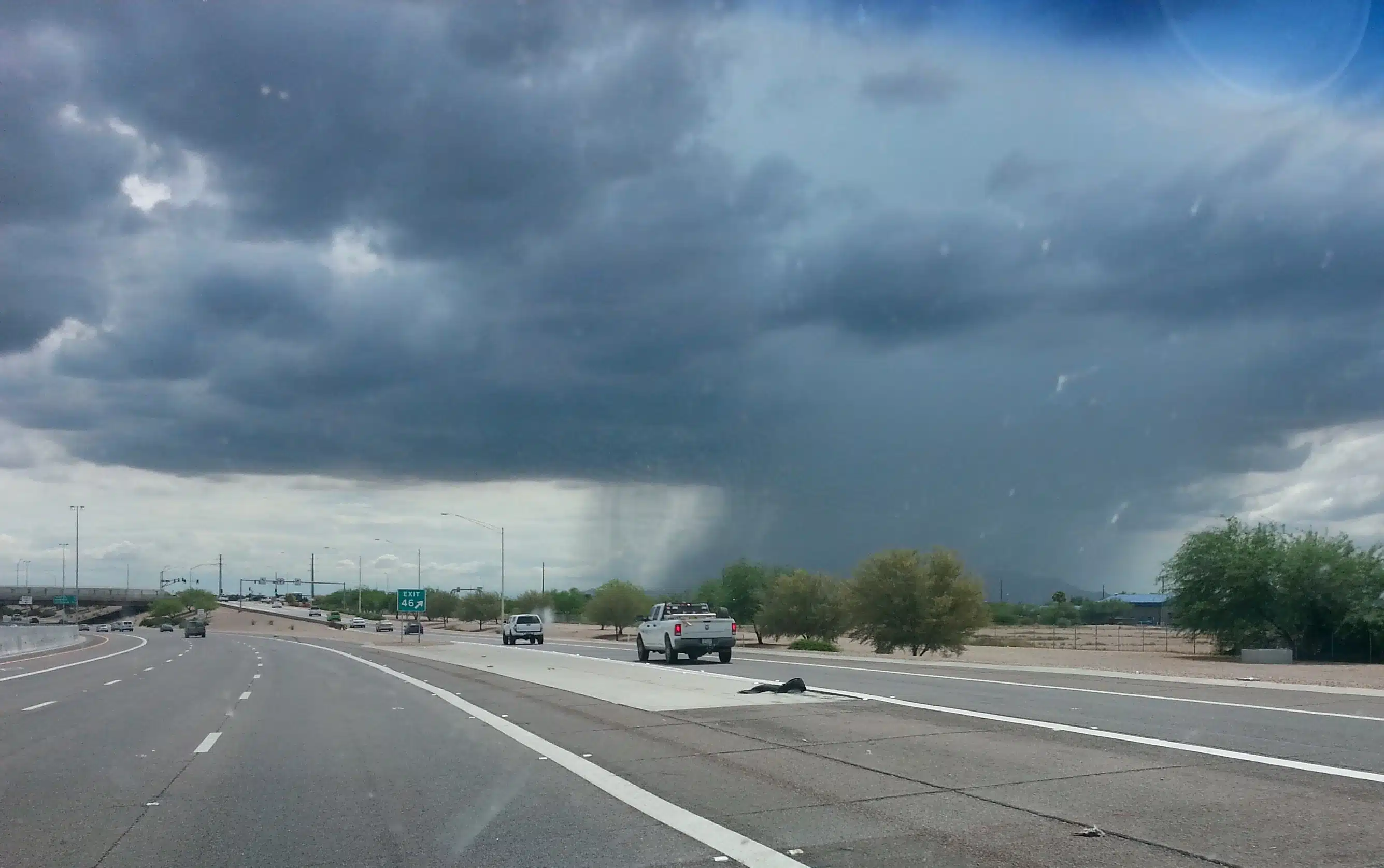
During the fall of 2025, Phoenix Sky Harbor received 6.31 inches of rain. This surpassed the former fall record of 6.18 inches set in 1939.
To put that into perspective, most of Phoenix’s 2025 rainfall arrived during a concentrated period late in the year. September recorded 2.26 inches, October recorded 3.26 inches and November added another 0.79 inches.
October included two new daily rainfall records. Sky Harbor received 0.70 inches on October 11 and 1.97 inches on October 12. The previous October 12 record was only 0.32 inches, set in 1957.
Phoenix ended 2025 with 8.31 inches of rain, slightly above the annual average. The full year was not record wet because the first part of 2025 had been dry. The fall itself, however, was extraordinary.
Rain in the desert changes more than the amount of water in the ground.
It changes the productivity of the environment.
Rain can increase plant growth, seeds, organic matter, shelter and moisture. Those conditions can support crickets, cockroaches and many of the smaller insects that make up the food supply for spiders and scorpions.
Bark scorpions do not simply respond to rainfall as a single event. They respond to what develops around them.
More moisture can mean more prey.
More prey can mean better feeding opportunities.
A strong food supply can support activity and survival across several levels of the desert food chain.
We cannot take a regional rainfall total and use it to calculate the exact number of additional scorpions on an individual property. But record fall rainfall created conditions capable of supporting substantially more biological activity than a normal dry fall.
That expectation is consistent with the cricket, cockroach and general-pest pressure our teams have observed this year.
The Warm Winter Reduced the Normal Seasonal Slowdown
After the wet fall, Phoenix did not move into a strong, sustained cold period.
January 2026 was considerably warmer than normal. The National Weather Service reported an average high of 72.3°F, compared with the normal 67.6°F. That was 4.7°F above normal.
Warm winter conditions matter because temperature influences insect and scorpion activity.
Bark scorpions do not disappear from the environment during winter. They find protected harborages and greatly reduce their activity during colder periods. They may gather in block walls, structural voids, bark, stored materials and other areas that provide protection.
Colder temperatures help create a seasonal slowdown.
A warmer winter can shorten or weaken that slowdown. It may allow intermittent movement and foraging to continue during periods when colder conditions would normally keep pests less active and deeper within their harborages.
I would describe this as reduced seasonal suppression.
I would not claim that the warm winter alone created more scorpions. The more important point is that the wet fall developed environmental productivity and the warm winter did less than usual to slow the system down.
The conditions carried forward.
Then March Arrived Months Ahead of Schedule
March 2026 did not bring a gradual spring warm-up.
It brought historic heat.
The National Weather Service reported that Phoenix reached 105°F on March 19, 20 and 21. The previous all-time March record was 100°F.
The average March high was 92.9°F, which was 14.8°F above normal. March’s average temperature was 78.8°F, or 12.5°F above normal.
That is not a small seasonal variation.
For pests whose activity is influenced by temperature, it represented a major shift in timing.
Warm nights allow bark scorpions to leave their harborages and range across properties. They move through block walls, landscaping, trees, irrigation zones and exterior building surfaces while searching for prey, shelter and favorable microclimates.
That activity normally increases as Phoenix moves from spring toward summer.
In 2026, temperatures associated with much later in the season arrived in March.
This does not mean every scorpion emerged on the same day or that activity increased equally in every neighborhood. Properties have different ecology, construction, irrigation, landscaping and surrounding pest pressure.
It does mean that the regional temperature signal moved forward very quickly.
The active season did not wait for the calendar.
Banner Poison Center Was Already Reporting Early Stings
Banner Poison & Drug Information Center provides another independent indicator of what we are seeing in the field.
During the first quarter of 2026, Banner documented 305 reported scorpion stings in Maricopa County, including:
- January: 46 reported stings
- February: 62 reported stings
- March: 197 reported stings
By the end of April, the cumulative total had increased to 564 reported scorpion stings, with 259 additional stings reported in April alone. The progression is striking. Phoenix went from 46 reported scorpion stings in January to 197 in March and 259 in April, showing that reported human encounters accelerated rapidly as record heat arrived months ahead of the traditional peak season, which Banner identifies as July through September.
Banner also states that more than 8,000 people in Arizona contact a poison center about scorpion stings during a typical year. More than 90 percent of those callers are reportedly managed safely at home, although children can face a higher risk of serious symptoms.
Poison Center reports are not a direct measure of the outdoor scorpion population. They are a measure of reported human encounters. However, when those reports are viewed alongside the National Weather Service’s record weather data and our own field observations across the Phoenix metropolitan area, they provide another independent line of evidence that 2026 has developed differently from a typical year.
Anyone who is stung should contact Poison Control for individual guidance, particularly when a child is involved.
What We Are Seeing in the Field
Official weather data tells us what happened regionally.
Banner’s reports document early human encounters.
Our field work shows how these conditions are presenting on individual residential properties.
During the 2026 season, Seal Out Scorpions has observed:
- Heavy cricket pressure
- Increased cockroach and general-pest activity
- Bark scorpion activity earlier in the season
- Juvenile scorpions on active properties
- Significant pressure around irrigated landscaping
- Activity along block walls and structural transition zones
- Scorpions concentrating around doors, garages and other accessible entry areas
- Homes requiring more adaptation than a fixed, calendar-based treatment program provides
The pressure is not identical everywhere.
One home may sit within a highly active neighborhood but have strong structural protection. Another may have moderate outdoor pressure but a weak building envelope. A third may be well sealed in most areas but have failing weatherstripping at one exterior door.
This is why counting scorpions alone does not fully explain risk.
We evaluate both sides of the problem:
How much pest pressure is acting against the property, and how well can the property resist it?
This is the basis of our Barrier Integrity Principle:
The protective barrier must be stronger than the pest pressure acting against it.
In a year of elevated pressure, barriers are tested more often and over a longer period.
Why Crickets and Roaches Matter to Scorpion Pressure
Scorpions are predators.
Crickets, cockroaches and other small insects are not simply separate pest problems. They are part of the food structure that can support scorpion activity.
This is one reason general pest management is an important part of scorpion risk management.
A treatment program that focuses only on killing visible scorpions can miss the larger system operating around the home.
We need to ask:
- What is supporting the prey population?
- Where are insects harboring?
- How is irrigation affecting the property?
- Are block walls functioning as protected movement systems?
- Are landscaping and debris creating favorable microclimates?
- Are general-pest treatments reducing prey effectively?
- Are products and applications appropriate for bark scorpions?
- Are treatments being timed to actual conditions?
- Can scorpions enter the structure when they reach it?
This is where scorpion control becomes Scorpion Risk Management.
The goal is not just to react after someone sees a scorpion in a bedroom.
The goal is to understand the system that allowed the risk to develop.
Why the Same Pest-Control Program May Perform Differently This Year
Many pest-control programs operate on a fixed schedule.
The technician comes every month, every other month or every quarter. The same general product may be applied at roughly the same time and in roughly the same places.
That may be adequate for general maintenance under ordinary pressure.
Nature, however, does not follow a service calendar.
When record rain, a warm winter and historic spring heat occur in succession, the risk window changes.
Pests may become active sooner. Prey may be more abundant. Treatments may be exposed to different environmental conditions. Properties may experience more movement and more entry attempts.
The answer is not necessarily to apply more pesticides everywhere.
The answer is to make the program more intelligent.
That can include:
- Better inspection
- More targeted product selection
- Correct treatment concentrations
- Crack-and-crevice work
- Treatment of relevant harborages and pathways
- Monitoring prey pressure
- Adjusting seasonal timing
- Property cleanup or habitat modification
- Reinforcing vulnerable door zones
- Building Performance Sealing
- Ongoing inspection of mechanical pest barriers
The program should respond to the property and the conditions, not simply the date on the calendar.
A Sealed Home Still Has Components That Wear
One of the most important lessons from our building work is that not all seals fail in the same way.
Static seals
Static seals do not move during ordinary use.
Examples include properly completed seals around:
- Plumbing penetrations
- Duct boots
- Wall fixtures
- Utility entries
- Cabinet penetrations
- Baseboard and framing gaps
- Other fixed openings within the building envelope
When the correct materials are selected and properly installed in appropriate locations, many of these seals can provide long-term performance.
Mechanical seals
Mechanical seals move, flex and compress.
Examples include:
- Door weatherstripping
- Door sweeps
- Threshold seals
- Garage side seals
- Window weatherstripping
- Sliding-door seals
- Pet doors
- Access panels
These are wear components.
Their performance depends on continued contact and compression. Rubber, foam and vinyl must maintain their shape against a mating surface as doors and windows open and close.
Arizona heat, ultraviolet exposure, normal use, building movement and material aging can reduce that performance.
A weatherstrip can still be present and look acceptable while no longer maintaining continuous contact.
That distinction matters with bark scorpions.
A scorpion does not need an opening that looks large to a homeowner. Small discontinuities at door corners, thresholds and mechanical transitions can become usable entry points.
This is why weatherstripping should not always be treated as a one-time correction.
It should be inspected as a maintenance item.
The original exclusion work may still be performing exactly as intended while a door seal installed years later, or used thousands of times, has gradually lost compression.
Three Systems Must Work Together
This season demonstrates why no single service should carry the entire responsibility for protecting a home.
-
Building Performance Sealing™
Building Performance Sealing addresses fixed structural openings and weaknesses within the building envelope.
Its purpose is to reduce the number of pathways pests can use to enter the structure.
-
Pest Barrier Integrity Systems
Pest Barrier Integrity Systems address the performance of mechanical and maintainable barriers over time.
This includes inspecting, adjusting and replacing weatherstripping, thresholds, garage seals and other components that wear through use and exposure.
-
Scorpion and General Pest Risk Management
Risk management addresses the living pressure acting against the structure.
It includes prey reduction, monitoring, targeted treatment, seasonal timing, property conditions, education and adaptation to changing environmental pressure.
These systems do not compete with one another.
They perform different jobs.
Pest management reduces pressure.
Building Performance Sealing reduces structural access.
Barrier maintenance helps keep mechanical access points performing.
A strong program uses each layer where it is needed.
Does a Bad Pest Year Mean Every Home Needs to Be Sealed?
No.
It means every home should be evaluated according to its actual risk.
Some homeowners may need a better general-pest program.
Some may need specialized scorpion treatment.
Some may have obvious door or garage vulnerabilities.
Some may have significant construction openings that cannot be overcome through pesticides alone.
Some may already have strong structural protection and need only seasonal maintenance.
The purpose of professional evaluation is not to sell every possible service to every homeowner.
It is to identify which part of the system is failing.
That is how we approach residential Scorpion Risk Management.
What May Happen Next
We should be cautious about treating a seasonal forecast as a guarantee.
Weather outlooks are probabilities. Conditions can change, and monsoon rainfall varies significantly across the Phoenix metropolitan area. One neighborhood may receive a major storm while another remains largely dry.
The correct operational position is to remain responsive.
If Phoenix continues to experience above-normal heat, scorpion activity can remain elevated for an extended period. If monsoon moisture increases cricket, cockroach or other insect activity, that could further support the prey base on active properties.
Rain can also disrupt harborages and change where pests move.
The effects will not be identical everywhere, but we should not expect the pressure created through fall, winter and spring to disappear simply because the calendar reached July.
The system has momentum.
What Homeowners Should Do Now
Homeowners do not need to panic, but this is not the best year to ignore recurring signs.
Pay attention to:
- Increasing cricket or cockroach activity
- Scorpions repeatedly appearing near the same door
- Scorpions in bedrooms, bathrooms or living areas
- Daytime scorpion sightings
- Juvenile scorpions
- Gravid females or females carrying young
- Gaps beneath exterior doors
- Weatherstripping that no longer maintains contact
- Garage-door corner gaps
- Changes in landscaping or irrigation
- A pest-control program producing poorer results than before
A single scorpion can occasionally enter through an open door or arrive with an object.
Repeated interior activity is different.
It suggests that pressure, pathways or both require closer evaluation.
The Bigger Lesson From 2026
The weather raised the regional pest threat.
The outcome at each home depends on the condition of the property, the surrounding environment, the pest-management program and the performance of its barriers.
This is why we do not see scorpion management as a single chemical treatment or one-time sealing project.
We see it as an integrated system.
After more than 26 years of working with Arizona homeowners, I know that scorpion problems can be complicated. But complicated does not mean random.
There are reasons pests are present.
There are reasons some homes experience repeated interior activity while neighboring homes do not.
There are reasons a program works in one season and struggles in another.
Our job as a Regional Specialist is to study those conditions, explain them and determine where the property is vulnerable.
Once we understand the system, we can begin changing it.
About Georgia Clubb & Seal Out Scorpions®
Seal Out Scorpions is led by Georgia A. Clubb, Advanced Scorpion Specialist, together with William L. Clubb and Michael C. Golleher — Certified Building Analysts and Envelope Professionals through the Building Performance Institute, with additional Building Science Certificates and studies in Urban & Industrial IPM through Purdue University. Their team includes licensed pest management and sealing specialists who pioneered Building Performance Sealing to solve scorpion problems at the structural level.